

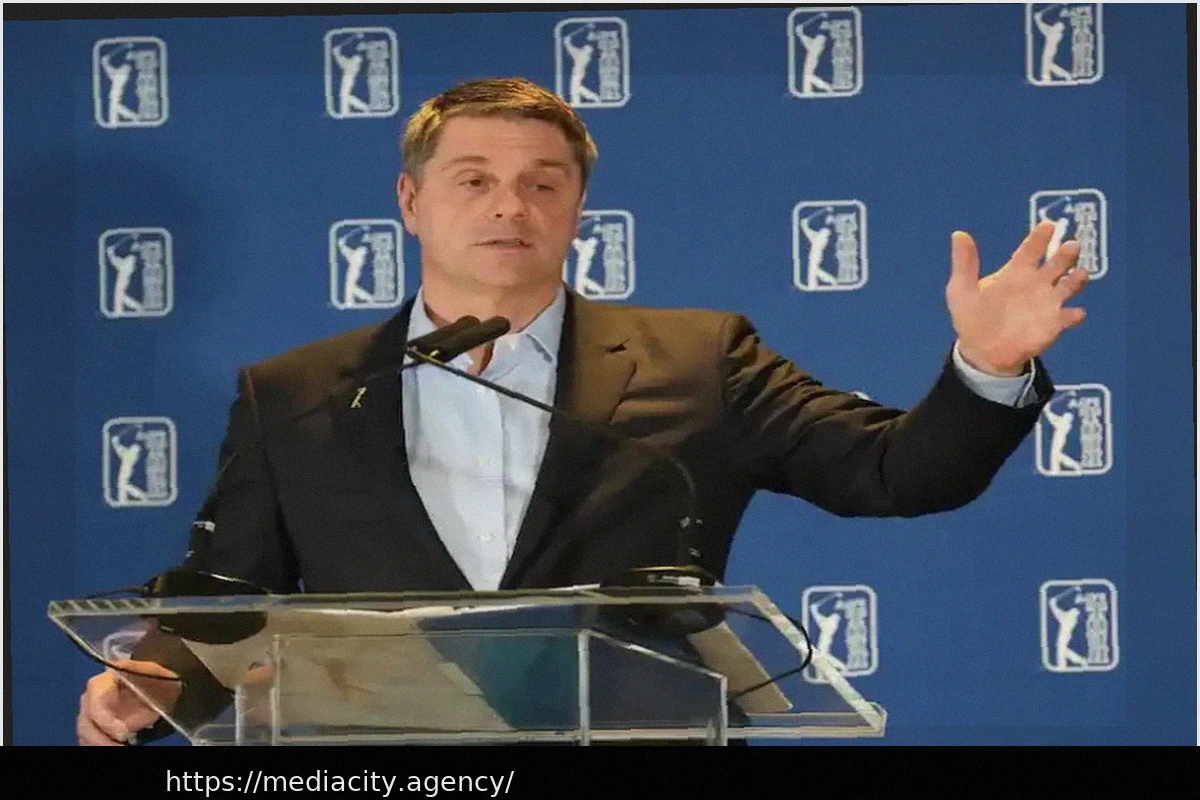
Brian Rolapp has initiated a significant restructuring of the PGA Tour, slated for implementation in 2028. This comprehensive reimagining signifies a fundamental reset for the organization.
The process mirrors preparing a home for sale, involving an honest assessment of its condition, identifying weaknesses, and determining necessary renovations to maintain its value. The PGA Tour finds itself in a similar situation. The escalation of prize money, largely driven by LIV Golf, was a reactive and unsustainable short-term strategy.
With new leadership and financial backing, the 57-year-old sports business model is transitioning from reacting to reinventing itself.
Rolapp, formerly of the NFL and now the Tour’s CEO and soon-to-be Commissioner, has collaborated closely with players, notably Tiger Woods, who heads the Tour’s Future Competition Committee. Woods’ involvement, particularly after recent personal challenges, highlights the importance of this initiative and the widespread support it has garnered.
“This endeavor was never about a single player or individual,” Woods stated, addressing the public for the first time since his DUI arrest and subsequent rehabilitation. “It was about consolidating diverse viewpoints, engaging in candid and difficult discussions, and thinking boldly about what best serves the sport we all cherish.”
The core of this transformation is a dual-tiered competitive framework: a Championship Series and a Challenger Series. These will operate simultaneously, linked by a system of promotion and relegation.
The PGA Tour Championship Series will comprise approximately two dozen events, featuring fields of around 120 players from February to August, with no alternates or sponsor exemptions.
“When fans watch the PGA Tour Championship Series, they can be confident they’ll see the world’s top players competing directly against each other,” Rolapp commented.
The CEO and future Commissioner mentioned that ten of the fifteen anticipated major events have already been confirmed.
Concurrently, the PGA Tour Challenger Series will function as a development ground and a pathway to the top tier. It will feature larger fields, lower prize purses, and a clear route for advancement. The financial disparity is significant: top-tier events will offer prize money of at least $20 million, while the feeder circuit will have purses around $4 million.
A particularly impactful change is the introduction of match play in the postseason, a format long favored by fans, which promises more engaging head-to-head competition. Additionally, the Tour Championship will become a nomadic event, moving away from its traditional home at East Lake Golf Club in Atlanta to become a rotating spectacle. This approach mirrors the Super Bowl, which does not have a permanent venue for its season-ending game, suggesting a similar strategy for professional golf’s climax.
This ambitious blueprint, developed through extensive consultation, demonstrates a willingness to challenge established structures. However, several questions remain. A key concern is how the Tour will effectively position and market the Challenger Series in an environment where attention, sponsorship, and media value are likely to concentrate on the higher tier.
This announcement brought to mind an executive town hall retreat at Walt Disney World nearly twenty years ago.
During a Q&A session, the then-President of ESPN, George Bodenheimer, was asked about his company’s success.
To the surprise of many, including some operational leaders, Bodenheimer admitted that ESPN had, at times, experimented with various strategies to see which ones would be successful.
On this particular June morning at the Travelers Championship, the PGA Tour has presented its own bold initiative – a two-tiered system, with more details to be revealed. The success of this plan will depend on its reception by players, partners, and, most crucially, the audience whose engagement, through media subscriptions, product purchases, and event attendance, ultimately sustains the sport.
English Translation
The PGA Tour’s Extreme Makeover is Underway
As Brian Rolapp stepped to the podium to unveil what amounts to a sweeping reimagining of the PGA Tour set to debut in 2028, it felt less like a routine announcement and more like the beginning of a structural reset.
It brought to mind a familiar process: putting a home on the market. Before the sign goes up, there is an inspection—an honest assessment of what works, what doesn’t, and what needs to be rebuilt to preserve value. In many ways, that is where the Tour has found itself. The prize money arms race sparked by LIV Golf was never a long-term solution. It was reactive, necessary in the moment, but ultimately unsustainable.
Now, with new leadership in place and fresh capital behind it, this 57-year-old sports business model appears to be moving from reaction to reinvention.
Rolapp, who came from the NFL, in his first year as CEO and now newly appointed Commissioner succeeding Jay Monahan upon his impending retirement, did not arrive at this moment in isolation. He convened players—most notably Tiger Woods, who has chaired the Tour’s Future Competition Committee—to shape the framework being introduced. Woods’ presence, particularly following a period of personal and public challenges, underscored the moment’s significance and the alignment behind it.
“This work was never about any one player or person,” Woods said in his first public appearance since his DUI arrest on March 27 and a subsequent rehab stint. “It was about bringing together different perspectives, having honest, hard conversations, and thinking boldly about what is best for the game that we all love.”
At the center of the overhaul is a two-tiered competitive structure: a Championship Series and a Challenger Series, operating concurrently and connected through promotion and relegation.
The PGA Tour Championship Series will feature roughly two dozen events, with fields of about 120 players competing from February through August, and no alternates or sponsor exemptions.
“When fans tune into the PGA Tour Championship Series, they know they will see the best players in the world competing head-to-head,” Rolapp said.
The CEO and soon-to-be Commissioner noted that 10 of the 15 anticipated marquee events have already been secured.
At the same time, the PGA Tour Challenger Series will serve as both a proving ground and a pipeline—larger fields, lower purses, and a clear pathway upward. The financial distinction is notable: purses of at least $20 million at the top tier compared to approximately $4 million on the feeder circuit.
But perhaps the most consequential shift lies in the postseason. The introduction of match play—long desired by fans—signals a deliberate move toward more compelling, head-to-head drama. Equally significant is taking the Tour Championship on the road, ending its long-standing annual residence at East Lake Golf Club in Atlanta and transforming it into a rotating spectacle. Hey, the Super Bowl doesn’t have a permanent home for its season-ending event, so why should professional golf?
It is, by any measure, an ambitious blueprint—one that reflects extensive consultation and a willingness to challenge legacy structures. Still, many questions remain. Chief among them: how the Tour will position and market the Challenger Series in a landscape where attention, sponsorship, and media value will inevitably concentrate at the top.
As I processed this announcement, I was immediately reminded of my own participation at an executive town hall retreat at Walt Disney World nearly two decades earlier.
During a question-and-answer session, someone asked then-ESPN President George Bodenheimer why his business was so successful.
Almost everyone was surprised, and some operational leaders were shocked to hear him say that the self-proclaimed Worldwide Leader in Sports had, from time to time, thrown spaghetti at the wall to see what stuck.
On this June morning at the Travelers Championship, the PGA Tour has served up its own ambitious platter of pasta Bolognese in the form of a two-tiered system, with more details to come.
Whether it proves to be a refined, palate-pleasing, easily digestible recipe or another well-intentioned experiment will depend on how it resonates—with players, partners, and, most importantly, the audience of consumers who ultimately fund the feast by subscribing to media partners who pay the PGA Tour for compelling content, buying sponsor products, and attending live sporting events.