

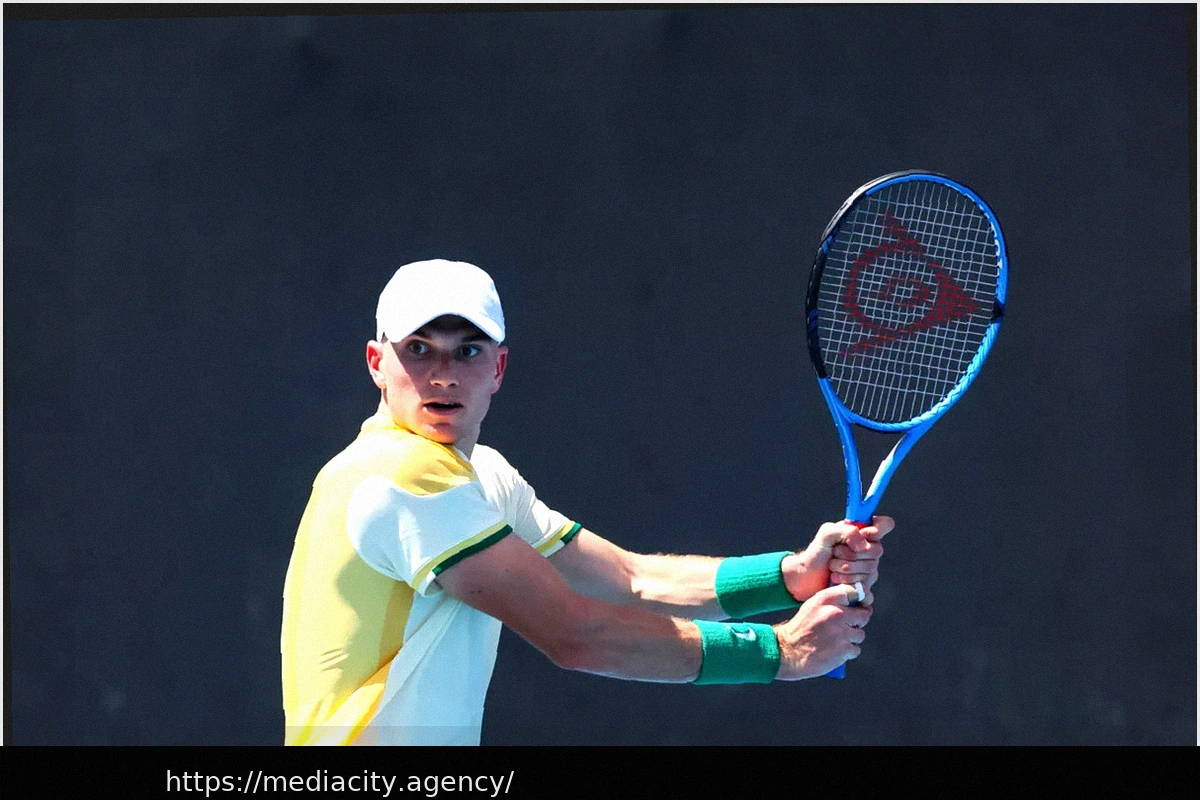
Tennis fans have become accustomed to a particular kind of disappointment: a promising young player emerges, achieves remarkable success, climbs the rankings, and then inexplicably fades. Often, this vanishing act isn’t due to a slump but because their bodies simply give out. Arthur Fils, Jack Draper, and Jakub Mensik stand out as three of the most gifted players of their generation, each displaying the potential to become world number one on their best days. However, they have also spent a concerning amount of time on the treatment table instead of the court.
The pertinent question is not merely whether these three have been unlucky. It’s whether the pattern of injuries they’ve accumulated by their early twenties signals a genuine threat to their long-term careers, or if these are simply growing pains that elite players often navigate on their ascent to the top.
Are Arthur Fils, Jack Draper, and Jakub Mensik Too Fragile?
The Injury Ledger Is Already Heavy
It’s worth detailing their injury histories, as the cumulative picture is striking.
In May 2025, Arthur Fils suffered a stress fracture in his back at Roland Garros, forcing him to withdraw before the third round. He attempted a premature return in Toronto but had to pull out of the US Open shortly after, citing warning signs during his comeback. His recovery continued, leading him to miss the Australian Open, keeping him off the tour for approximately eight months. What makes Fils’s situation particularly concerning is that this wasn’t an isolated incident. He has had back issues since the age of 15, including a herniated disc in his L5 vertebra. By his own admission, his back is a structurally fragile part of his body that he will likely have to manage throughout his career.
Jack Draper’s injury history reads like a medical encyclopedia. He was sidelined in 2023 and 2024 due to abdominal and shoulder injuries, while hip tendinitis disrupted his preparation for the 2025 season. He battled through three consecutive five-set matches at the Australian Open, only to retire in the fourth round against Carlos Alcaraz due to hip tendinitis, admitting he had been taking significant painkillers to compete. Then, just as he was playing some of the best tennis of his career, winning a Masters 1000 title at Indian Wells and reaching a career-high ranking of world number four, a bone bruise in his left humerus ended his season and forced him to miss the following year’s Australian Open.
Mensik, born in 2005, is the youngest of the three, yet his injury log is already surprisingly extensive. An elbow problem in 2024 significantly impacted his clay-court season and necessitated a complete rebuild of his serve motion. He nearly withdrew from the 2025 Miami Open due to severe knee inflammation before a physiotherapist convinced him to compete, and he went on to win the title. At the 2026 Australian Open, he reached the fourth round before withdrawing with an abdominal muscle injury. He has since pulled out of Monte-Carlo with a toe injury. He is still only 20 years old.
The Tour Itself Is Part of the Problem
It would be too convenient to attribute these issues solely to the individual misfortune of three young men. The broader context is crucial. In 2025, the ATP Tour saw 37 instances of players retiring mid-match or withdrawing from tournaments, matching the highest number for that point in the calendar over the past two decades and representing a roughly 50% increase compared to the annual average. This is not a mere coincidence. Men’s Grand Slam matches are now, on average, 23% longer than they were in 1999, yet the average number of tournaments played by top 100 players has remained largely unchanged during the same period.
Players are hitting with more power, covering more ground, and competing on slower courts that demand longer rallies and greater physical exertion, all within a schedule that lacks a meaningful off-season. The rate of walkovers and retirements due to injury at Grand Slam and Masters 1000 events in 2025 reached 5.5%, a significant margin above the 20-year average of 3.8%. Many players have voiced their concerns, but their complaints have largely gone unheeded.
For young players like Fils, Draper, and Mensik, who are still physically developing while simultaneously being required to compete at the highest level week after week, the system is particularly unforgiving. Their bodies have not yet fully adapted to the demands of a mature professional athlete, yet they are already bearing the full brunt of the tour’s intensity.
Reason for Concern, Not Despair
The reassuring counterargument is that this pattern mirrors the journey of almost every great player. Novak Djokovic faced significant wrist problems early in his career. Rafael Nadal has spent entire seasons managing a left knee that many believed should have ended his career a decade earlier. Even Roger Federer, whose longevity is now considered almost mythical, had his most dominant years interrupted by mononucleosis and knee surgery. The difference between these players and those who faded permanently was rarely talent. It was largely dependent on the quality of their medical support, their wisdom in making critical decisions, and the physical fortune to avoid catastrophic structural injuries that are truly unmanageable.
The current situation with all three players suggests they understand the stakes. Fils has extensively discussed overhauling his diet and physical preparation during his eight-month absence, along with making technical adjustments to his forehand to reduce strain. Draper has acknowledged the need to manage his workload more intelligently and has brought in new coaching support. Mensik’s Masters 1000 title at 19 while playing through knee pain demonstrates his mental fortitude, though it also raises questions about whether the culture surrounding young players encourages them to push through warning signs rather than heed them.
The truly concerning cases in tennis history are not the players who got injured young. They are the players who suffered repeated injuries in the same area, ignored the underlying structural causes, and paid the price later. Del Potro’s wrist serves as a cautionary tale that expert observers already cite when discussing Draper’s arm issues. This comparison doesn’t imply Draper is doomed, but rather that the current conversations about biomechanics, scheduling, and load management are precisely the right ones to be having.
Fils, Draper, and Mensik are not inherently fragile in a way that should lead to their dismissal. They are fragile in the way that all elite athletes are when they are young, powerful, and being pushed too hard, too soon by a sport that has yet to effectively protect them from themselves. Their talent is undeniable, and their potential is extraordinary. Whether they reach it will depend less on their performance on the court and more on what transpires in the treatment room, and whether the ATP demonstrates the institutional will to acknowledge that its current schedule is quietly consuming its future stars.