

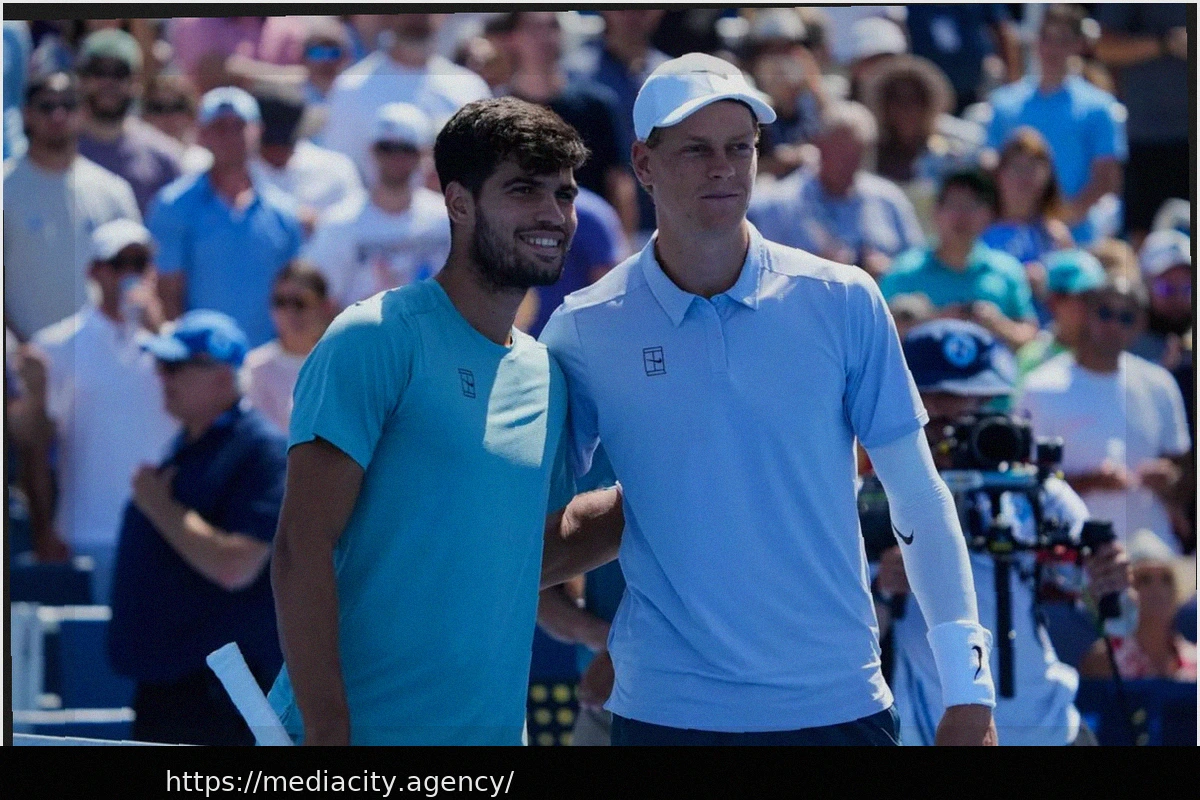
There’s a widely held theory in sports that the elite players in a discipline can collectively raise the overall standard of the game. This idea is currently being vividly demonstrated in tennis. The remarkable dominance displayed by Carlos Alcaraz and Jannik Sinner is compelling every other player to improve, and Alexander Zverev serves as a prime example of this phenomenon.
The Duo Nobody Can Avoid
Despite remaining the preeminent pair in world tennis, the first three months of the current season have passed without Carlos Alcaraz and Jannik Sinner facing each other on the court.
We were close to witnessing their encounters on two occasions. At the Australian Open, Novak Djokovic emerged as an obstacle, performing with renewed vigor reminiscent of his younger years in the semifinal and defeating Sinner. Later, at Indian Wells a few weeks ago, Daniil Medvedev delivered what was arguably his finest performance in the past three years, eliminating Alcaraz in the semifinal. A potential meeting in Miami was also thwarted when Sebastian Korda proved too formidable for Carlos Alcaraz.
These near-misses should not lead to any major conclusions. Alcaraz and Sinner undeniably remain, by a significant margin, the two best players in the world. It’s highly probable that for the foreseeable future, they will be the principal favorites to win every major tournament. They are exceptionally difficult to defeat even in a single match, and a confluence of specific circumstances is usually required for an opponent to overcome them.
Novak Djokovic had to summon his past brilliance to make a Grand Slam match competitive. Daniil Medvedev had to play his best match in three years on a quicker court at Indian Wells, against an Alcaraz who was already showing signs of needing a brief respite after an intense two-and-a-half months of continuous victories. Therefore, their supremacy remains largely intact. However, this situation is fundamentally beneficial for tennis, even if it doesn’t always appear that way.
This is not solely due to the emergence of what could be a historic rivalry, but also because players of Alcaraz and Sinner’s caliber inspire improvement in others. This effect might not be immediately apparent, and the first three months of the season might not fully reveal it, but it’s a gradual process that can be easily overlooked if one isn’t paying close attention. Their dominance compels their competitors to evolve and, ultimately, to strive for their highest potential.
Alexander Zverev exemplifies this evolution. Perhaps he is the most telling example.
The Player Who Stayed the Same Too Long
The German player has been consistently ranked among the world’s top five for nearly a decade, with only minor interruptions. Yet, it can still be argued that he hasn’t reached his absolute peak. He has secured numerous significant titles and maintained a high level of performance, an achievement that is perhaps not sufficiently appreciated. Nevertheless, the fact remains that his career still carries a sense of unfulfilled potential.
Many are quick to attribute Zverev’s shortcomings in crucial moments to a lack of mental fortitude, but this is an oversimplification. For years, his game has suffered from recurring structural issues, and his style of play has undergone minimal change during that period. This observation has been made not only by journalists and analysts, often with undue timidity, but also by tennis legends such as Roger Federer and Rafael Nadal. Despite this, Zverev largely maintained his established approach.
There were intermittent periods where he adopted a more aggressive stance, but these phases were typically sporadic and short-lived. The fundamental issue has consistently been his tendency towards passivity.
His forehand, in particular, highlights this problem. Examining his performance over the last 52 weeks, Zverev registers a 7.2% forehand winner rate per point, placing him among the lower percentages for top players in that timeframe, surpassed only by Alex de Minaur and Jiri Lehecka. While this sample size covers 21 matches, it closely aligns with his career average of 7.5%. Crucially, there are no significant technical deficiencies with his forehand; the issue lies not in his mechanics but in his disposition, stemming from a propensity for caution when aggression is what the situation demands.
In general, his development as a player has been limited over the years. His aggressive play has predominantly relied on his serve, supplemented by exceptional court coverage and an ability to absorb pace. This style enabled him to remain a consistent top-five player but proved insufficient for winning Grand Slam titles.
Over time, Zverev created a compounding problem: he repeatedly lost crucial matches, often in a similar fashion—by being overly passive, which in turn fueled the narrative surrounding his mental resilience. Simultaneously, another complicating factor emerged in the background: the evolving direction of tennis itself, where increasingly aggressive play distinguishes the very good from the truly great.
The Belated Pivot
Leading up to the current season, Zverev convened with his team, including his father and, for several years, his brother Mischa, and they finally agreed that certain adjustments were necessary. He has publicly acknowledged this, noting that he is managing to be more aggressive at times but still requires time and is not yet consistently effective. He has described accepting that losses will inevitably occur as a direct consequence of this change, as he is convinced it represents the correct path at this stage of his career.
It took him a considerable amount of time to reach this conclusion. Arguably, too much time. However, it is better to act late than never.
The increased aggression is now evident in his game, a fact that Marin Cilic experienced firsthand when he lost to Zverev in three sets in the third round in Miami. This enhancement extends beyond just his forehand; it reflects a broader tendency to attack more frequently: taking the ball earlier, taking greater risks on second serves, and aiming to finish points at the net rather than waiting for opponents to make errors. It is important to understand that this is an ongoing process, and some losses will result directly from stepping outside his comfort zone and implementing strategies that were not previously part of his repertoire. One such instructive loss occurred in the Indian Wells semifinal against Sinner, where he displayed excessive aggression on his backhand, overcompensating in the opposite direction. This is a real-time illustration of transition. It is often messy, inconsistent, and occasionally costly, but the alternative—remaining unchanged—had already demonstrated its limitations over half a decade of near-misses.
Will this transform him into a better player? Most likely. However, in his specific case, it may have come too late.
Zverev never truly cultivated a winning mentality in the most significant matches and, overall, did not evolve sufficiently as a player during the years when such development would have been most impactful. He will soon turn 28, and his game still lacks the strategic variety demanded by the highest echelons of the sport, a regrettable assessment for a player who has spent a substantial part of the last decade in the top five.
And all of this stems from his long-standing reluctance to honestly assess what needed to change. Until now, when the undeniable dominance of Alcaraz and Sinner has compelled this adjustment. Because this is precisely the impact that players of their caliber have on those around them.
Waiting for the Third
While their dominance might make most players seem outmatched, in the long run, this superiority initiates a process that is fundamentally positive for the sport. They compel players to adapt and constantly seek avenues for improvement. This is why it is reasonable to anticipate a strengthening of competition in the coming years, not only due to a surge of exciting young players with genuine top-ten potential but also because Alcaraz and Sinner will push each of them to achieve their best selves.
And this is where the emergence of a potential third contender begins to materialize. We are not making predictions or naming specific individuals, but it is an inevitability born from the pressure that true greatness exerts on its surroundings. The history of tennis demonstrates that dominant duos do not suppress competition indefinitely. Instead, they elevate it. They establish a standard so high that the only players capable of surpassing it are those who were compelled to fundamentally rebuild themselves in pursuit of that goal.
Somewhere on the tour right now, an individual is undergoing precisely this transformation. The Alcaraz-Sinner era will eventually produce its challenger. The only remaining question is who will reach that pinnacle first.