

“`html
A tennis score of 6-0 6-0 is known as a double bagel. It’s a term that sounds almost whimsical, which is somewhat misleading given the total humiliation it represents. Twelve games. Zero for the loser. Not a single game held on serve, not a single break point converted. Essentially, matches where not a single moment felt like anything other than an execution. It happens, of course, no matter how minimal the chance, but it should not happen when both players are professionals at the top of the sport. Yet in the past year, it has happened twice in matches that belong in entirely different categories of explanation. At Wimbledon last July, Iga Swiatek dismantled Amanda Anisimova in a Grand Slam final. At Monte-Carlo this week, Matteo Berrettini did the same to Daniil Medvedev in a Masters 1000 second round. Two bagels, two very different stories.
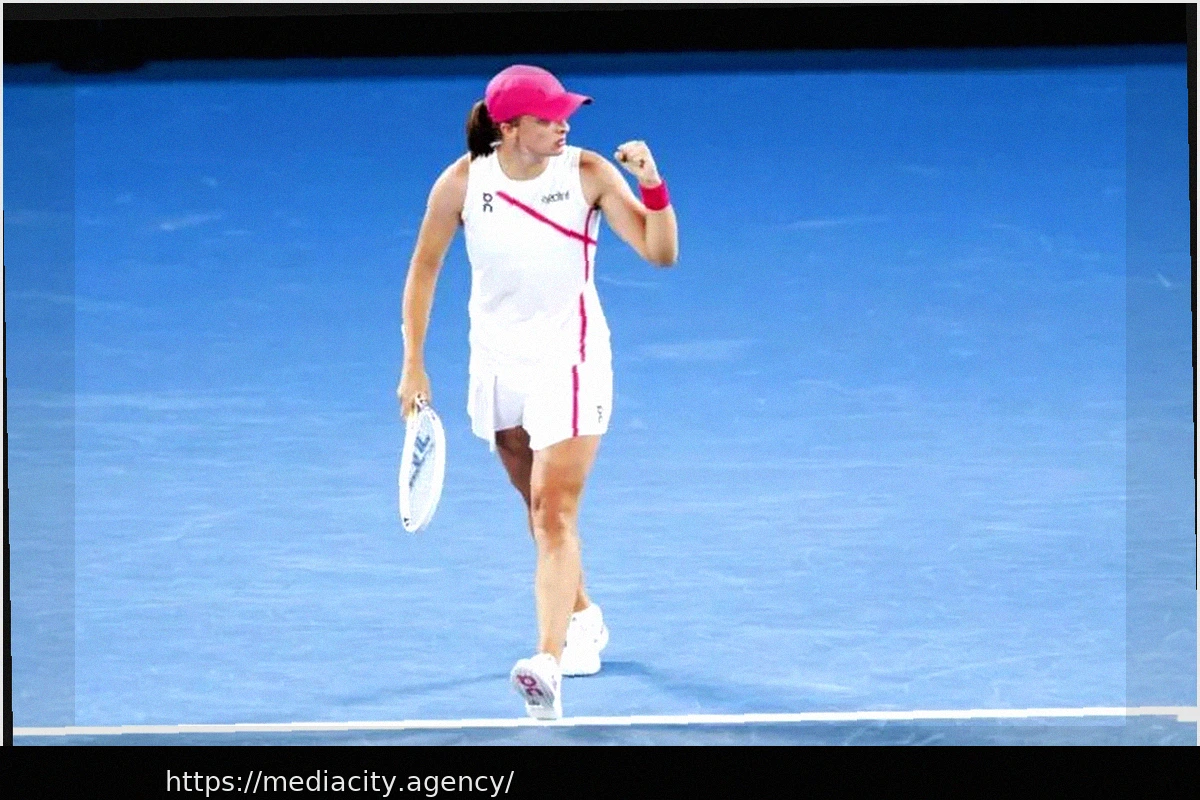
Anisimova vs Swiatek, Wimbledon Final 2025
To understand how a Grand Slam final ended 6-0 6-0, you need to understand the two forces that met on Centre Court that afternoon, and what happened when one of them stopped functioning.
Anisimova had arrived at the final as one of the summer’s most compelling stories. She had beaten Aryna Sabalenka in the semifinals, playing a flat, penetrating ball-striking style that makes her a serious threat on any surface. Her forehand is as heavy as almost anyone on the women’s Tour, and her backhand down the line, when it is working, is close to a weapon of complete disruption. On paper, this was not a one-sided matchup. Swiatek had, in fact, struggled at Wimbledon for years. Her heavy topspin doesn’t work as well as it does on clay, which meant that she had never been past the quarterfinals at the All England Club before that campaign.
What actually happened in the final was a near-perfect collision of Swiatek at her sharpest and Anisimova at her most overwhelmed. Swiatek broke in the opening game, and Anisimova made 14 unforced errors in the first set alone, including three double faults, unable to win a game in the opening 23 minutes. The serve, which had been her platform all fortnight, crumbled first. She made just 45% of first serves across the match, and Swiatek returned all 19 first serves she faced and won 74% of those points. When the first serve is going in under half the time, the second serve becomes the primary shot in play, and against Swiatek’s return game, that is an untenable position. Every second serve is an invitation.
The tactical bind deepened from there. Anisimova’s game is built around early contact and flat pace, designed to rush opponents before they can settle. Swiatek’s court coverage is exceptional, her movement giving her the time to reset under pace that would overwhelm most players. When Anisimova attacked, Swiatek was already back behind the ball. When Anisimova tried to extend rallies to manage the nerves, she drifted into Swiatek’s preferred territory of long crosscourt exchanges that the Pole wins by attrition. Swiatek finished the final having missed just three backhands from 63 attempts on that side, winning all eight points played at deuce during the second set. There was simply nowhere for Anisimova to go.
The psychological dimension cannot be separated from the technical one. This was Anisimova’s first Grand Slam final. The occasion had been building for two weeks. She had used enormous emotional energy in the semi-final against Sabalenka, and she later acknowledged that she had run out of gas a bit in the final, feeling frozen by nerves from the start. That frozenness is not a weakness of character. It is what happens when the body cannot release the accumulated stress of a fortnight of match pressure in the biggest moment of a career. Swiatek, by contrast, had won five Grand Slams before stepping onto that court. The final felt enormous for one of them. For the other, it felt like Tuesday.
It was only the second double bagel in a women’s Grand Slam final in the Open era, the previous one being Steffi Graf’s demolition of Natasha Zvereva at the 1988 French Open. The rarity of the scoreline reflects how rarely all of these factors converge: a player of the highest quality performing near-flawlessly, an opponent whose game plan falls apart structurally in the opening minutes and cannot be reconstructed once the momentum of a blank scorecard begins to compound. Anisimova needed to score a game. Every time she was close, Swiatek found a backhand, or a passing shot, or an ace on a crucial point. The chance never came.
Medvedev vs Berrettini, Monte-Carlo 2026
Where the Wimbledon final was an almost pure case of elite oppression, the Monte-Carlo match was something more chaotic. Medvedev did not simply face a player who outperformed him. He produced one of the most spectacular individual collapses seen at a Masters event in years.
The context matters enormously here. Medvedev was playing his first clay-court match of the season, arriving off the back of hard-court titles in Dubai and Brisbane. Clay is a surface he has never hidden his distaste for, famously asking to be defaulted during a Rome match in 2021 and describing clay season’s end as a relief. His game, which depends on flat driving from the baseline, precise angles and a serve that kicks awkwardly on hard courts, translates imperfectly to the slower, higher-bouncing conditions of red clay. The ball sits up for his opponents. His serve loses its edge. The margin for error shrinks.
Berrettini, ranked #90 and playing on a wild card, was the wrong opponent for a player already wrestling with the surface. The Italian’s game is built precisely for clay with a kick serve that generates almost impossible bounce, a forehand that builds pressure through pace and spin, and the physical presence to maintain intensity over long points. He is also a former Wimbledon finalist who has spent years working back from injury, meaning he arrived at Monte-Carlo with nothing to lose and everything to prove. That combination, tactically and psychologically, is a difficult thing to face when your own confidence in the conditions is already fragile.
Medvedev landed just 36% of first serves throughout the match, won nine points on his own delivery across the entire contest, and hit three winners against 27 unforced errors. He did not hold a single game point on his serve. The pattern of the collapse was visible almost immediately. He had two break points in the opening game and missed both. From that moment, he won only seven points in the entire first set, which Berrettini took 6-0 in 26 minutes.
The break-point failure in the first game is worth dwelling on, because it illustrates how quickly a tennis match can tip. Medvedev was a point from going a break up in the opening game of a match he was expected to win. Two missed returns later, the dynamic shifted. Berrettini held and then broke immediately. On clay, which rewards patience and punishes rushed shot-making, Medvedev responded to being broken by pressing harder. Pressing harder on clay against a well-organised opponent means more errors, which means less confidence, which means more pressing. It is a spiral that is very hard to arrest once it starts.
In the second set, with the match at 6-0 2-0, Medvedev smashed his racket repeatedly, picking it up from the clay and driving it back down six times before placing what remained in the bin. That moment tells you everything about the mental state in which he was in. He was not losing a close match. He was being humiliated on a surface he dislikes, by a wild card he had beaten three times before, in a Masters 1000 where his seeding gave him every advantage. The rage was not just frustration at the result. It was a fury of a player who cannot do the thing he knows how to do, watching himself produce tennis that bears no resemblance to his actual level.
Berrettini later said he had missed just three shots all match, describing it as one of the finest performances of his career. He is probably right. But the performance was made possible in part because Medvedev handed him the conditions to thrive: relentless errors, a broken service game, and a psychological state that deteriorated with every lost point rather than steadying.
Not All Bagels Are Alike
These two scorelines share a format and nothing else. Swiatek’s bagel was the product of suffocating, near-faultless tennis applied to an opponent whose game could not breathe. Berrettini’s was the product of one player performing well enough and another player dissolving under the specific conditions that expose his weaknesses most. In the Wimbledon final, Anisimova was beaten. In Monte-Carlo, Medvedev largely beat himself, with Berrettini providing a little push to make it happen.
What unites them is the compounding nature of the scoreline itself. Tennis rewards momentum more relentlessly than almost any other sport. A game won gives the winner confidence, which makes the next game easier to win. A game lost makes the next service game feel heavier. Once a player trails 3-0 without having held serve, the pressure on each subsequent service game is considerable. The crowd knows it and the players know it too. Ultimately that can contribute to the player not being able to reset and simply spiral. Anisimova could not reset because Swiatek gave her nothing to reset from. Medvedev could not reset because the surface had stripped him of his tools and his temper had stripped him of the rest.
A double bagel, at the end of it all, is the sport’s way of announcing that on one particular day, in one particular match, two players were not playing the same game.
“`