

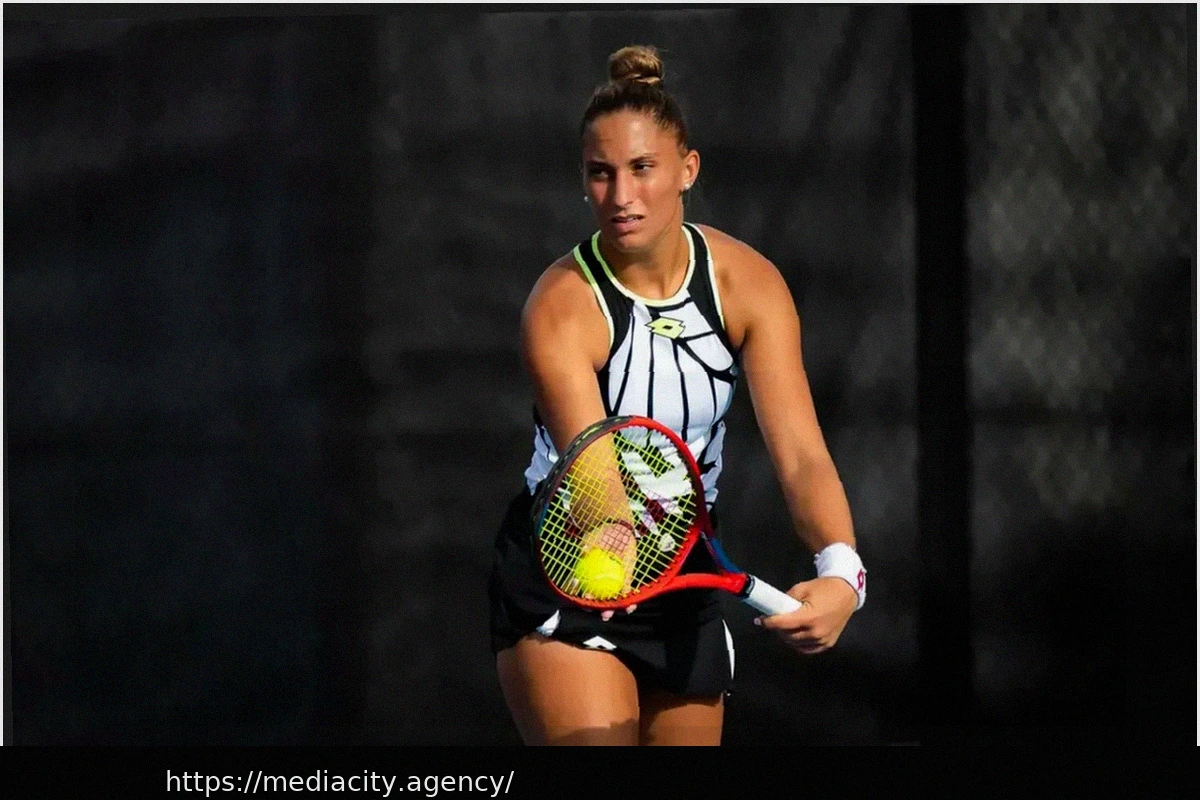
The intense world of professional tennis, where every point can dramatically alter outcomes, is increasingly overshadowed by the pervasive influence of sports betting. A recent alarming incident involving Hungarian tennis player Panna Udvardy has brought global attention back to the significant risks betting poses to athletes and the integrity of the sport.
Udvardy disclosed receiving anonymous, threatening WhatsApp messages the night before her quarter-final match at the WTA 125 tournament in Antalya, Turkey. These threats explicitly warned that her family would be harmed unless she deliberately lost the match. The messages were deeply disturbing, including photos of her family, details about their vehicles and home addresses, and even an image of a firearm, leaving the 27-year-old in profound fear for her loved ones’ safety.
She immediately informed authorities, resulting in police protection at the event and for her family at home. Despite the heightened security, Udvardy went on to lose the match against Ukraine’s Anhelina Kalinina with a score of 7-6 (7-3), 7-5.
Udvardy stressed that her experience was not unique, indicating that other players have faced similar intimidation. Just days prior, Italian player Lucrezia Stefanini reported receiving comparable threats before a qualifying match at Indian Wells. The Women’s Tennis Association (WTA) has confirmed multiple players have been affected and is investigating how personal information was obtained by the perpetrators, with the source still unknown.
Udvardy’s ordeal underscores a broader crisis within tennis. The explosion of both legal and illicit betting has fueled attempts at match-fixing, a surge in online abuse, and even direct heckling at events. These issues collectively undermine the sport’s integrity and significantly impact players’ mental well-being.
The Dark Side of Sports Betting
Tennis now ranks as the third most-bet-on sport globally, behind only football and horse racing. While partnerships between tennis tours and betting firms generate substantial revenue, this financial benefit comes at a severe cost. Gamblers, often enraged by lost wagers, frequently barrage players with death threats, violent images, and personal attacks via social media.
In 2024 alone, data compiled by Signify Group revealed approximately 8,000 abusive, violent, or threatening comments targeting 458 players on social media platforms. A concerning 40% of this detected abuse originates from “angry gamblers,” typically coinciding with match results and containing references to betting.
Beyond online harassment, match-fixing remains a persistent problem, with organized crime groups pressuring players to manipulate results for financial gain. The issue also extends to live events, where bettors have been known to heckle players during matches, seeking to disrupt their performance or express frustration.
The Mental Health Crisis Among Athletes
The psychological impact of this constant abuse on athletes is immense. After physically and mentally exhausting matches, players are often met with a torrent of hatred, a situation that has become disturbingly normalized. Katie Boulter, who has personally received explicit images alongside threats, voiced particular concern for younger players, fearing the long-term damage to their mental resilience.
The perpetual anxiety over personal safety, family welfare, and career reputation fosters stress, depression, and burnout. In lower-tier Challenger events, where prize money is considerably lower, the abuse intensifies. Players frequently report receiving numerous death threats following losses, amplifying the mental strain in an already demanding profession.
Furthermore, gambling addiction among athletes themselves introduces another layer of risk, potentially leading to match-fixing as a desperate measure to clear debts. This further compromises their mental health and the fairness of the game. Such an environment erodes trust in the sport; fans may question legitimate losses as potential fixes, and players themselves second-guess their performances under a cloud of suspicion. The ultimate outcome is a sport where mental strength is tested not only on the court but also in the digital and physical spaces increasingly dominated by betting interests.
Charting a Course for Protection
For many within the tennis community, the Udvardy case serves as a stark warning: the rapid expansion of global sports betting has outpaced existing safeguards designed to protect athletes. Addressing this escalating crisis demands a multi-pronged approach involving governing bodies, betting operators, and law enforcement.
The WTA and the International Tennis Federation (ITF) have already implemented AI-powered tools, such as Threat Matrix, to detect and mitigate online abuse, and are urging the gambling industry to share responsibility. Enhanced monitoring of betting patterns is crucial for early detection of suspicious activity, as demonstrated by historical investigations like the 2007 Davydenko case, which scrutinized unusual wagers.
To counter in-person heckling and threats, tournament organizers must strengthen security protocols, including prompt ejection of disruptive fans and establishing anonymous reporting systems for players. Essential support includes educational programs for athletes on how to manage abuse, coupled with robust mental health services. Regulating betting partnerships, such as re-imposing bans on deals involving lower-tier events, could diminish incentives for corruption.
Betting companies must invest in dedicated integrity units to track and report anomalies, while governments need to enforce stricter laws against illegal syndicates. Players are advocating for greater platform accountability, pressing social media giants to curb anonymous harassment. As Udvardy has filed a police report in Turkey, more such actions, bolstered by international cooperation, could act as a significant deterrent to perpetrators.
Ultimately, safeguarding tennis requires prioritizing player welfare above revenue. Without decisive action, the sport risks losing its fundamental essence—fair competition—to the corrosive forces of unregulated gambling. As courageous voices like Udvardy’s emerge, the entire tennis community must unite to ensure that no athlete steps onto the court in fear.