

Mercedes’ overwhelming superiority in the first two races in Australia and China has provided a clear picture of the championship landscape. As the F1 season moves to Suzuka, a circuit more aerodynamically akin to Australia but with fundamentally different key factors, the trailing teams currently sit 0.4-0.5 seconds behind. A major unknown is the expected high development gradient for all teams, which is anticipated to significantly influence performance from late spring onwards. Suzuka’s unique layout will present fresh challenges and opportunities to assess car behavior on a track less reliant on sheer engine power compared to Melbourne and Shanghai. The critical question remains: will this change in circuit characteristics be enough to narrow the performance gap currently dominated by Mercedes?
Suzuka: One of the Least Power-Limited Tracks, Yet Energy Recovery Poses a Challenge
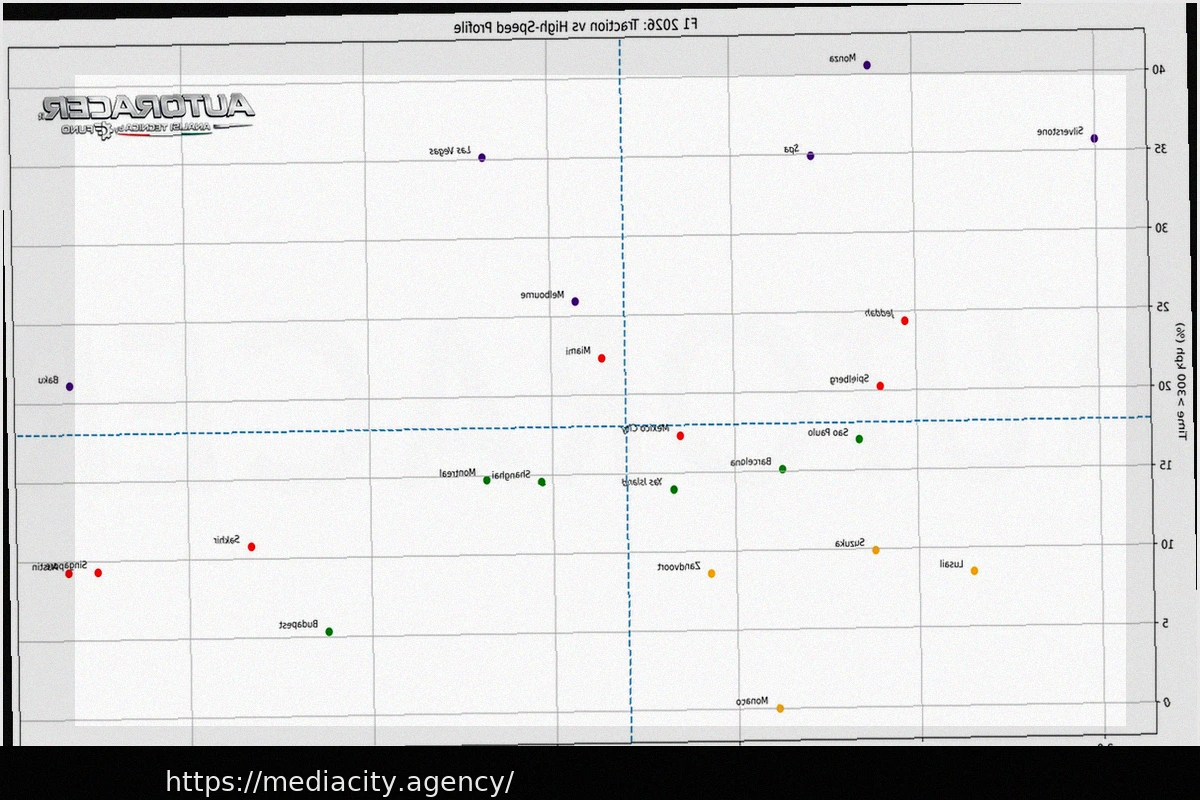
Preliminary analyses indicate that the historic Suzuka circuit is significantly less dependent on engine power than Shanghai and particularly Melbourne. In fact, it ranks among the least demanding circuits from a power unit perspective, alongside Monaco, Zandvoort, and Losail. This characteristic raises the possibility of a more closely contested battle at the front. Initial team simulations appear to support this for Shanghai, and the expectation carries over to Suzuka. However, Mercedes’ straight-line advantage stems from a distinct approach during cornering phases – areas where the SF-26 has previously set the benchmark. It is precisely in these corners that the W17s build a portion of their straight-line speed advantage. Even at Suzuka, a circuit rated medium in terms of electrical management difficulty, Mercedes’ Power Unit advantage is expected to further enhance its energy recovery capabilities.
The 5807-meter Japanese circuit offers limited opportunities for energy recharging due to the scarcity of heavy braking zones. Estimates suggest that just over 3 MJ can be recovered per lap, a substantial drop compared to Shanghai and a figure more in line with Australia, where electrical energy management proved problematic during qualifying and the race. In this initial phase of the season, only Monaco, Budapest, and Shanghai present an easier energy balance. This week, we anticipate a return to the energy management issues observed in the season opener. The “Super Clipping” phenomenon is set to re-emerge. Without extended sections exceeding 300 km/h, drivers may find themselves compelled to recharge batteries in some of the circuit’s most iconic areas: the Esses in the first sector are at risk (where lower speeds make recharging less efficient), and 130R will almost certainly be affected by Super Clipping.
Despite having a similar recharging capacity to Melbourne, Suzuka will demand 4 MJ less per lap. The track features fewer traction zones, and crucially, the time spent above 300 km/h will decrease by approximately 15%. The most intricate section is undoubtedly from the exit of the hairpin through the approach to Turn 1, where even in 2025, drivers experienced clipping on the final part of the main straight. This 3500-meter segment encompasses the two most critical traction zones on the circuit, counterbalanced by limited opportunities for energy recovery. In the second half of the lap, drivers will spend just over 500 meters under braking. Consequently, we can expect intensive use of Super Clipping – even during qualifying laps – and a notably higher number of overtakes and re-overtakes compared to Suzuka’s average in previous seasons.
Sakhir and Jeddah Excluded: Impact on New Power Units and Championship Dynamics
The removal of the Bahrain and Saudi Arabian races from the calendar could significantly boost Ferrari’s championship aspirations. Given Mercedes’ undeniable superiority in the early stages of the season, competing on two circuits highly demanding on the Power Unit would have undoubtedly extended Russell and Antonelli’s lead in the standings. Of the two, Sakhir, a stop-and-go circuit with moderate hybrid stress, would have been less detrimental to the SF-26. Conversely, the Jeddah layout would have been perfectly suited to the W17’s strengths: high hybrid stress and strong Power Unit dependency over a lap would have showcased the Brixworth powertrain’s advantages, especially its efficiency through high-speed corners where Mercedes and Ferrari currently appear closely matched.
At present, the championship battle clearly involves George Russell and Kimi Antonelli, with Russell’s greater experience giving him an initial edge over his younger teammate. However, as demonstrated in 2025, a significant early-season advantage does not guarantee dominance throughout the year. Beyond aerodynamic updates – where Ferrari must prove its ability to maintain pace with other top teams consistently – it will be crucial for them to close the engine performance gap as quickly as possible. During the Chinese Grand Prix weekend, it was revealed that Ferrari is developing a ‘provisional’ power unit aimed at stabilizing the compression ratio at a higher level, thereby improving performance and durability to closer match Mercedes. In this context, the ADUO tokens and the decisions regarding evaluation periods are indispensable for Ferrari to approach the benchmark Power Unit. However, the rivals are certainly not standing still.