

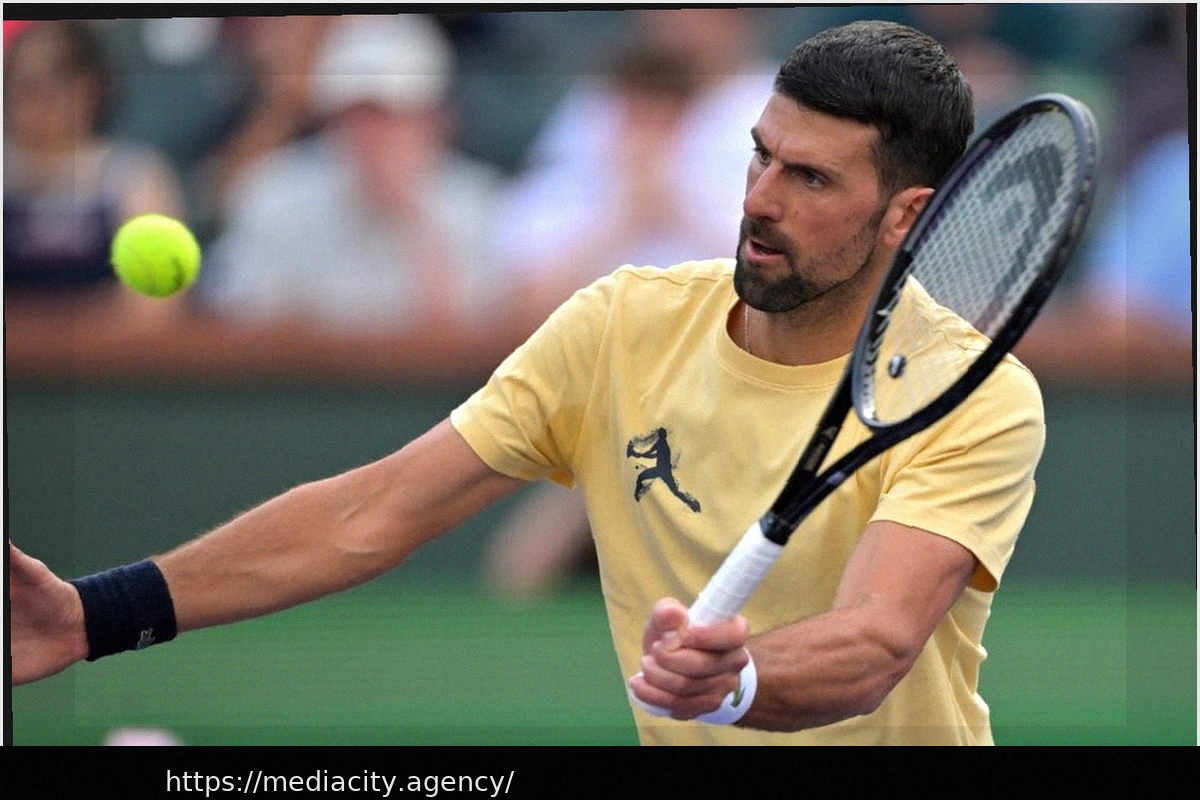
This Wednesday evening at Indian Wells features a compelling fourth-round clash: Novak Djokovic faces Jack Draper. While officially a Masters 1000 encounter, its underlying narrative is far richer. We witness the 38-year-old, 24-time Grand Slam winner – who recently confessed to a lack of enjoyment in the sport – stepping onto the court against the 24-year-old reigning champion of this very tournament. It’s a confrontation of current titleholder versus five-time legend, youthful exuberance against storied past, the present challenging history.
Yet, surprisingly, this high-stakes matchup generates little buzz.
Djokovic’s Indian Wells Paradox: A Decade of Underperformance
The muted reaction around this match offers insight into Djokovic’s current standing in the 2026 tennis dialogue. His record at Indian Wells since his 2016 triumph is perplexing: consecutive losses to players like Taro Daniel, Philipp Kohlschreiber, Luca Nardi, and Botic van de Zandschulp. Despite being widely regarded as the sport’s greatest hard-court player, boasting 751 wins and an 84.4% success rate (the highest among active players), he hasn’t advanced past the quarterfinals here in nine years. This week alone, he endured three-set battles against Kamil Majchrzak and Aleksandar Kovacevic, neither typically a threat to the top 50. While his 2026 season stands at a commendable 7-1, with the sole defeat coming against Carlos Alcaraz in the Australian Open final – an excellent season by most standards – an underlying issue seems to persist.
A Champion’s Candid Confession
“To be honest, I’m not always enjoying myself,” he stated candidly, devoid of any self-pity, following his match against Majchrzak. It wasn’t merely a complaint, but rather a frank assessment. For three decades, this is a man who has masterfully channeled his internal world to dominate on the court, transforming psychological combat into an art form, thriving on animosity from crowds as others draw energy from acclaim. Now, he concedes that his drive is waning. The extraordinary ‘machine’ remains operational, but its intricate operator is clearly fatigued.
Djokovic and Draper’s sole prior encounter was at Wimbledon in 2021, a match Djokovic won 4-6, 6-1, 6-2, 6-2 when Draper was a virtually unknown 19-year-old. Draper, who has admired Djokovic since childhood, once praised him, saying, ‘He’s the greatest player of all time, consistently proving it year after year. He is truly the ultimate champion.’ These are gracious sentiments, yet also remarkably astute. In the years since that Wimbledon defeat, Draper has evidently grasped a crucial lesson: overcoming Djokovic requires more than mere reverence for his legendary achievements. One must respect the icon, but then focus entirely on challenging the opponent standing across the net.
Facing the Present-Day Djokovic
Tonight, Draper will not be facing the Djokovic of 2021, nor the formidable champion of 2015 or any of his record-setting prime years. The Serbian arrives in California exhibiting a sharpness that hasn’t quite matched Draper’s recent form. Draper’s powerful left-handed serve and aggressive baseline game represent precisely the type of challenge that has troubled Djokovic in his more advanced years – players who can dictate rallies, preventing the extended exchanges where Djokovic’s mental fortitude traditionally wears down opponents. Kovacevic, for instance, delivered 16 aces in their third-round match, snatching a set. Draper is poised to serve with greater potency and move more effectively.
And yet, a crucial factor remains: Djokovic holds a 1-0 lead in their head-to-head. His only defeat in 2026 was to the player widely regarded as the world’s finest. Time and again, just as commentators begin to predict his decline, and the wear and tear of age appear undeniable, he unearths a new reserve. At the Australian Open, for example, he was trailing Musetti before the Italian retired, then conjured a classic five-set victory against Sinner in the semifinals, only to narrowly lose to Alcaraz in the final. His body may signal fatigue, but his will consistently overrides it. He may not be finding joy in every moment, yet his winning ways persist.
A Legacy Beyond Statistics
This singular characteristic sets Djokovic apart from almost any other modern athlete and complicates the experience of watching him in 2026. He’s no longer pursuing records; he owns them, with 24 Grand Slams. The World No. 1 ranking, now held by a 22-year-old who defeated him in finals, is not his current objective. He isn’t striving for relevance by conventional measures. At 38, he stands as the second-oldest man to reach the third round at this event, surpassed only by Ivo Karlovic in 2019. His career now unfolds within purely historical contexts.
So, what exactly fuels his continued presence?
Draper, speaking with the reverence of someone who grew up watching the legend, acknowledged that Djokovic’s mental game would be formidable and that he would present an extremely tough challenge. He is undoubtedly correct. However, the unspoken question beneath this observation – why Djokovic continues to push so hard, and for whom – remains largely unaddressed within the tennis world. His opponents, out of immense respect, shy away from it. Journalists, having chronicled his career for two decades, likewise hesitate. Even Djokovic himself, when queried about his enjoyment, offered a competitor’s evasive response, immediately followed by a winning point.
The Showdown Awaits
Tonight is the night of the match. Draper, the defending champion, is returning from injury, securing his first consecutive wins in nine months, and will play before a supportive home crowd. Djokovic, conversely, hasn’t advanced to the quarterfinals here since 2016. All current statistics and recent form seem to indicate a clear outcome. Yet, with Djokovic, statistics and form have often suggested one thing, only for the final score to tell a vastly different story.
He might not be finding joy in the game, but he could still emerge victorious. This, above all, defines his current legacy: a man who persevered long after the enjoyment faded, simply because quitting was an option he never truly understood.