


The annual NBA Christmas Day schedule traditionally features the league`s top contenders. Following a thrilling set of holiday matchups, we survey these 10 teams, analyzing their true potential for a championship run. For each team, we highlight one representative statistic that provides the greatest reason for hope and one that signals a significant concern regarding their title aspirations. The teams are ordered by their probability of reaching the Finals, according to ESPN’s Basketball Power Index (BPI).

Oklahoma City Thunder (26-5, 64.4% Finals Chance)
Oklahoma City`s defense is allowing 9.9 fewer points per 100 possessions than the league average this season. This is a historically unprecedented mark, surpassing the previous record held by the 2003-04 Spurs (8.8 points below average). After winning the title last season largely on the strength of the NBA’s best defense, the Thunder unit has reached an exceptional new level in 2025-26.
The Thunder’s dominant 24-1 start came against an extremely favorable schedule; only 12% of those games were against top-tier teams (Detroit, New York, or the top six in the West). However, 37% of their remaining 57 games are scheduled against these elite opponents. The defending champions are currently 3-4 with a minus-0.6 point differential against the league’s best. While they remain the clear title favorite, they must prove they can beat multiple top teams in the playoffs, something that hasn`t come as easily as their routine blowouts against lesser competition.

New York Knicks (21-9, 35.7% Finals Chance)
Wings Mikal Bridges, OG Anunoby, and Josh Hart are combining to shoot 40% from 3-point range (with all three at 38% or better). This is a significant improvement from last season. This improved spacing is crucial: if defenses cannot leave these wings open, they cannot easily send help defenders to stop Jalen Brunson and Karl-Anthony Towns, New York’s primary scoring threats.
Mitchell Robinson’s overall season free throw percentage stands at 40%, despite a recent improvement. Robinson’s size and offensive rebounding make him vital (New York has a plus-8.5 net rating with him on the floor), but his career playoff free throw percentage (39%) creates a huge vulnerability. If opponents can successfully deploy a “Hack-a-Mitch” tactic, it could severely undermine the Knicks’ postseason aspirations.

Denver Nuggets (21-8, 12.7% Finals Chance)
After years of staggering losses when Nikola Jokic left the floor, the Nuggets are finally holding steady. Denver’s net rating with Jokic on the bench has historically been between negative-7.9 and negative-10.4. This season, that figure is only negative-1.1. Offseason additions like Jonas Valanciunas, Bruce Brown, and Tim Hardaway Jr. have successfully stabilized the bench unit, a massive improvement that bodes well for maintaining leads in the postseason.
Denver boasts the most efficient offense in league history, but can their defense hold up enough to repeat as champions? They rank only 17th defensively, partly because a league-high 12% of their opponents` shot attempts are valuable corner 3-pointers, according to Cleaning the Glass. While opponents are shooting an average percentage on these attempts (37%), the sheer frequency of high-value looks is a concern.

Houston Rockets (18-10, 12.4% Finals Chance)
Thanks to Steven Adams, Alperen Sengun, and a massive rotation, the Rockets` offensive rebounding rate is 43% higher than the league average—the best margin in NBA history. In an era of generally low offensive rebounding, Houston’s rate is the highest recorded since 1994-95. This outlier skill, which generates crucial extra possessions, echoes the 2015-16 Thunder team that leveraged offensive rebounding to push the 73-9 Warriors to seven games in the conference finals.
Amen Thompson ranks last among high-volume shooters with a 26% effective field goal percentage (eFG%) on jumpers, while Sengun ranks near the bottom at 42%. While the team is buoyed by Kevin Durant and Reed Sheppard`s shooting, the team’s long-term success relies on the young duo of Thompson and Sengun. In playoff crunch time, featuring two non-shooters on the floor—or three if Adams joins—could make their half-court offense predictable and inefficient.

Cleveland Cavaliers (17-15, 9.9% Finals Chance)
Only two teams in the Eastern Conference have 10 or fewer losses. This means that despite their mediocre 17-15 record, Cleveland is just 1.5 games out of a top-four seed and home-court advantage in the first round. Coach Kenny Atkinson has cited the 2021-22 Celtics (who started 25-25 before surging to the Finals) as precedent. Given Cleveland’s talented but underachieving start, their primary hope lies in a similarly forgiving Eastern Conference path.
The Cavaliers are the only team significantly over the second salary apron, exceeding the threshold by more than $22 million. This financial constraint poses a major operational problem. The Cavaliers face severe restrictions on in-season transactions: they cannot aggregate salaries in trades, take back more money than they send out, or sign buyout players whose pre-buyout salary was above the league average. This severely limits their options to improve the underperforming roster.

San Antonio Spurs (23-7, 6.1% Finals Chance)
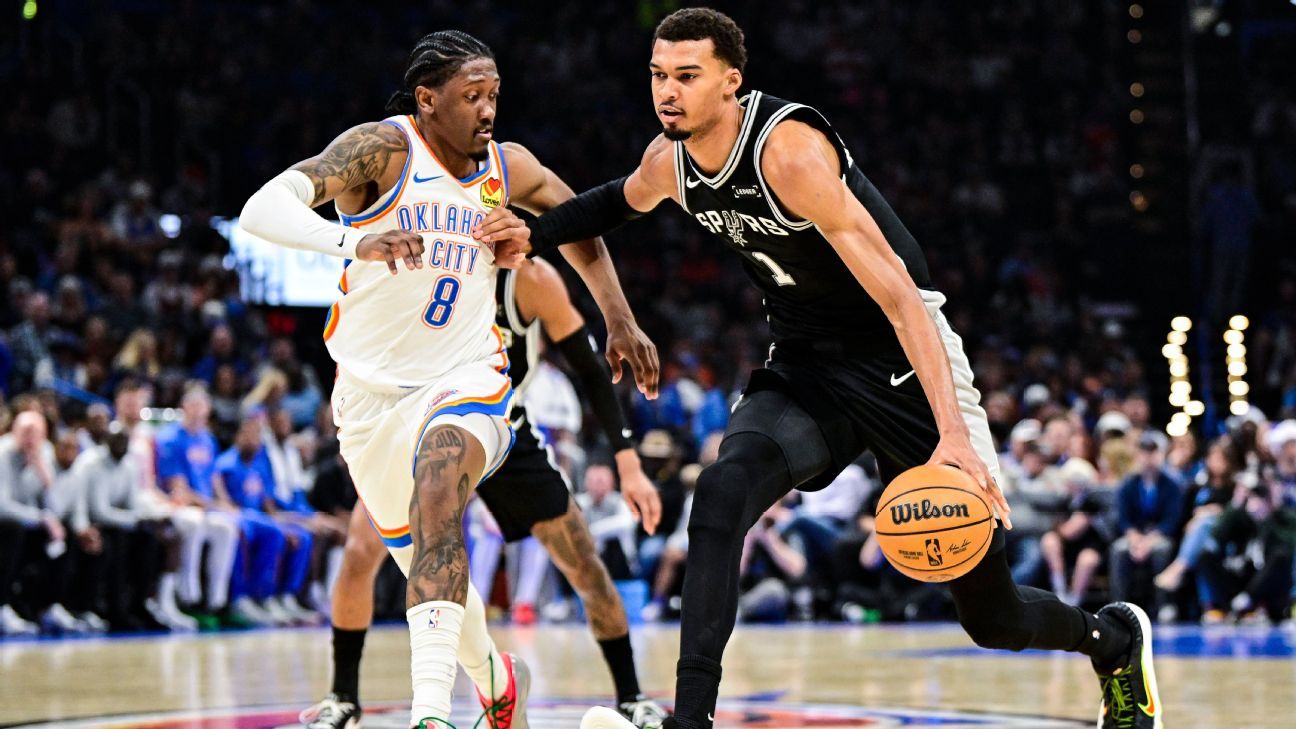
The Thunder have a historically great defense allowing 104.6 points per 100 possessions. However, when Victor Wembanyama is on the floor, the Spurs allow an even lower 101.7 points. Among high-minute players this year, Wembanyama ranks immediately behind the Thunder`s top defenders in individual defensive rating, showing his ability to transform an otherwise average defense into an elite, fearsome unit single-handedly.
Young guards Dylan Harper and Stephon Castle are shooting a combined 28.8% from behind the arc. While small-sample lineups featuring Castle, Harper, and Wembanyama have been statistically dominant (a staggering plus-51.1 net rating), their unsightly long-range percentages pose a warning sign for the playoffs. Locked-in defenses will inevitably crowd Wembanyama inside, forcing his young teammates to connect from the perimeter. Whether they can make those shots may determine if San Antonio is a legitimate Finals threat or still needs more time to mature.

Golden State Warriors (16-15, 1.2% Finals Chance)
The Warriors maintain a strong defense, boasting a 111.0 defensive rating—second best in the Western Conference only to the Thunder. Draymond Green has always emphasized that their championship teams were built on defense (they ranked 1st, 2nd, 11th, and 2nd defensively in their four title seasons). With this precedent, Golden State still profiles as a dangerous sleeper contender, relying on their defensive identity.
The strength of their defense is countered by a major offensive weakness that has kept them hovering near .500. The Warriors rank 23rd in offensive rating, the worst mark of the Stephen Curry era (excluding the injury-plagued 2019-20 season). A primary culprit is their lack of easy baskets, as they score just 42 points per game in the paint—the fewest of any team except the Nets. During their peak years (2014-2018), they consistently ranked in the top 16 in paint scoring; the current low ranking reflects a fundamental struggle to generate high-percentage looks.

Minnesota Timberwolves (20-10, 1.4% Finals Chance)
Despite ongoing debate about their point guard situation (after replacing Mike Conley with Donte DiVincenzo in the starting five), Minnesota`s new core lineup—DiVincenzo, Anthony Edwards, Jaden McDaniels, Julius Randle, and Rudy Gobert—has been exceptional. In a league-high 264 minutes, this five-man unit boasts a phenomenal plus-11.2 net rating. Only three five-man lineups with similar volume last season had a better net rating, and those teams all entered the playoffs as favorites or reached the Finals.
The one area where Minnesota’s lack of a traditional point guard is painfully evident is in late-game situations. The Timberwolves have a clutch turnover rate of 18.4%, by far the worst in the NBA. Turnover rate usually decreases in the clutch, but the opposite is true for Minnesota. These late-game giveaways have directly contributed to losses and represent a self-sabotaging pattern they cannot afford to repeat in the playoffs.

Los Angeles Lakers (19-10, 1.1% Finals Chance)
Clutch performance is often random, yet the Lakers hold a perfect 10-0 record in clutch games, a remarkable overachievement compared to their 9-10 record in all other contests. If any team is built to consistently overachieve in close games, it is the Lakers, who possess three elite creators (Luka Doncic, LeBron James, and Austin Reaves) and the best free throw differential in the league. No Western Conference contender would want to face this firepower in the final minutes of a tie game.
The Lakers` net rating suggests they “should” have only 14.1 wins, a 4.9-win gap from their actual record (19 wins)—the largest gap in the league. Simply put, there is no modern precedent for a champion with such a mediocre overall résumé. The Lakers are currently being outscored by 0.5 points per game, whereas the champion with the worst point differential in the modern playoff era was the 1994-95 Rockets (plus-2.1). Despite this, recent finalists have shown that a team can catch fire in the playoffs after a middling regular season.

Dallas Mavericks (12-20, 0.0% Finals Chance)
The Mavericks famously began the season without a true point guard, leading to significant offensive struggles. Since the undrafted rookie Ryan Nembhard joined the starting lineup on November 28, Dallas’s offensive rating has jumped by 12.0 points per 100 possessions. Before Nembhard, the Mavericks were 5-14 and ranked 30th in offense; with him running the unit, Dallas is 7-6 and boasts the No. 9 offense, No. 8 eFG%, and No. 9 turnover rate.
More than their immediate struggles, the Mavericks are concerned about the future stability of their core. Dereck Lively II, who looks like the team’s long-term center, has played just 98 total games (40% of available games) over three NBA seasons due to various injuries, including foot surgery that ended his 2025-26 campaign early. While Lively, Cooper Flagg, and Nembhard could form a great young core, relying on Lively to stay on the court is becoming increasingly difficult.
 Rupert Hollis