

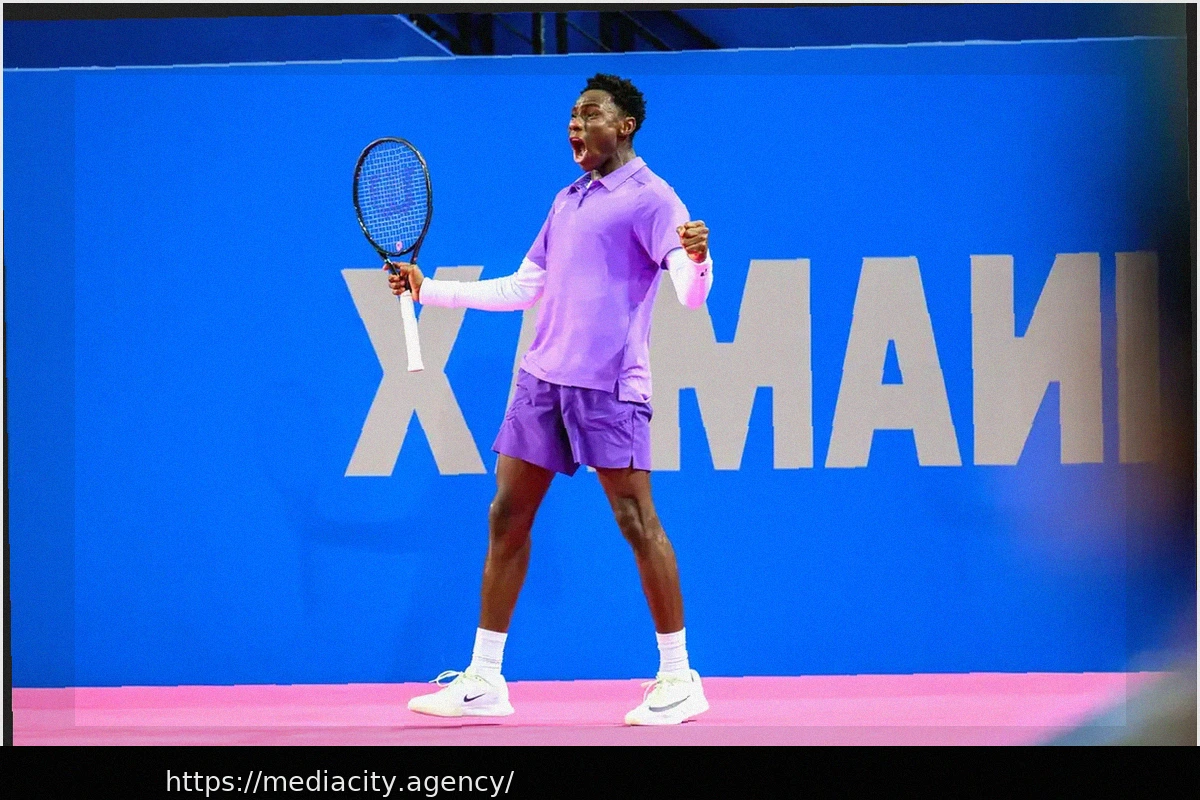
An unexpected wildcard entry, virtually unknown until recently, has emerged as the youngest Masters 1000 match winner since the legendary Rafael Nadal. This marks the grand introduction of Moise Kouame, French tennis’s most intriguing new talent.
Moise Kouame: A Rising Star
From Sarcelles to the Global Stage
Sarcelles, a northern Parisian suburb, is hardly synonymous with producing elite tennis players, more recognized for its urban landscape and proximity to Charles de Gaulle Airport than for sporting prowess. Yet, in 2015, a six-year-old boy named Moise Kouame picked up a racket there, guided by his older brother Michael, and a remarkable journey began. Just last week, on a Miami hard court, Kouame, at only seventeen, made history by becoming the youngest player since Rafael Nadal in 2003 to secure a victory in a Masters 1000 match. With fewer than twenty ATP matches under his belt, it’s clear he’s only just begun.
His inaugural win against American qualifier Zachary Svajda was no mere stroke of luck or convenient draw. Kouame demonstrated exceptional skill, delivering eleven aces and converting three out of four break points. He narrowly clinched the match by a single aggregate point, winning 102 to Svajda’s 101. Far from a straightforward victory, it was a testament to his immense character, battling through a grueling two-hour and seventeen-minute encounter (5-7, 6-4, 6-4) where every point was hard-won. He subsequently exited the tournament in the second round, losing to 21st seed Jiri Lehecka (6-2, 7-5). However, considering Lehecka’s subsequent run to the semifinals, this defeat offers no cause for concern regarding Kouame’s potential.
Historical Context of Kouame’s Achievement
Kouame’s achievement places him in incredibly exclusive company. Only three players in history have secured a Masters 1000 victory at a younger age:
- Richard Gasquet, aged 15 years and 301 days
- Rafael Nadal, aged 16 years and 315 days
- Nicholas David Ionel Pescariu, aged 17 years and 10 days
- Moise Kouame, aged 17 years and 12 days
Furthermore, Kouame is the first player born in 2009 or later to claim a win in any ATP-level match.
The names on this list – Gasquet and Nadal – are titans of the sport, far from obscure. Significantly, Richard Gasquet, a former world number seven who retired at the 2025 French Open, has taken on a technical advisory role for Kouame. Gasquet provides what Kouame calls “essential ballast,” understanding the unique pressures of professional competition at a young age from his own experience. He offers a crucial blend of serenity and mental fortitude, both on and off the court, that a purely tactical coach cannot match.
Gasquet has also been proactive in shielding his protégé from the common pitfall for promising young French players: comparisons to Gael Monfils. He firmly asserts that Kouame is an individual with his own unique path, much like Carlos Alcaraz forged his own identity despite initial parallels with Nadal.
A Rapid Ascent in 2024
Kouame’s progress this year has been nothing short of meteoric. January saw him secure consecutive ITF titles in Hazebrouck and Bressuire, marking him as the first player born in 2009 to win a professional tournament and commencing the season with an impressive 12-match winning streak. By February, despite being ranked 833rd, he successfully qualified for the ATP main draw in Montpellier, overcoming Swedish number one Elias Ymer and fending off 10 of 13 break points in a grueling three-hour qualifying epic. This made him the sixth-youngest ATP qualifier of the century.
The same month, he advanced to a Challenger semifinal in Lille, breaking into the top 400 rankings for the first time. This was followed by the pivotal Miami wildcard entry, his historic win against Svajda, and a new career-high ranking of 385, set to improve further in the upcoming post-Miami rankings. In just four months, Kouame has rocketed from world No. 833 to near the top 300, transitioning from regional French ITF events to the grand stage of a Masters 1000 in Florida. Truly an extraordinary trajectory.
Kouame’s Playing Style and Background
Standing 6 ft 3 in and still maturing physically, Kouame embodies the modern French school of aggressive baseline play, akin to Ugo Humbert or Arthur Fils. His style emphasizes early ball striking and a proactive approach, rather than defensive rallying. Developed by coach Yoann Le Mee in his early years, his game thrives on seizing time from opponents. His serve is already a formidable asset, recorded at over 220 km/h at Hazebrouck in January, indicating significant untapped physical and technical potential.
Kouame’s personal journey is multifaceted. Born in Sarcelles to an Ivorian father and a Cameroonian mother, he left home at thirteen to train at the Justine Henin Academy in Belgium, followed by a stint at the Mouratoglou Academy in Biot. Recognizing his exceptional talent, the French Tennis Federation has since provided institutional backing, assigning national Davis Cup coach Laurent Raymond to his team this year, highlighting the need for structured support alongside natural ability.
Despite this support, his coaching pathway has been somewhat tumultuous. A series of high-profile coaches, including Gilles Simon, Philippe Dehaes, Mouratoglou, Raymond, and Gasquet, have been part of his team in rapid succession. This instability was highlighted by French media outlet RMC in February. Kouame’s career is co-managed by his mother and the IMG agency, with reports suggesting Dehaes’s abrupt mid-tournament dismissal. This evolving dynamic warrants attention; while some athletes navigate such turbulence seamlessly, others find it detrimental. For a seventeen-year-old whose career is still in its formative stages, this remains a key aspect to observe.
Future Outlook and Potential
Kouame openly declares his aspiration to become world number one – a common ambition among young talents that often remains unfulfilled. However, the caliber of names accompanying his on the record-breaking list presents a compelling case for his potential. Jannik Sinner, one of the first of his generation to secure an ATP win, ultimately ascended to the world number one spot. Similarly, Carlos Alcaraz, the first of his peers to achieve this, has already claimed seven Grand Slams. While a single milestone doesn’t guarantee future success, the historical trajectory of those who reach it at such a young age is highly indicative.
The Miami tournament truly showcased Kouame’s remarkable composure. His ability to recover from losing the first set and then meticulously fight back to win in three demonstrates a unique mental resilience that cannot be taught. It demands the capacity to internalize a setback, adapt strategies instantly, and perform under intense pressure, all without the safety net of prior experience or an established reputation. Kouame exhibited all this at just seventeen, in his debut Masters 1000 main draw, captivating an audience that quickly rallied behind him.
He will celebrate his eighteenth birthday in March 2027. By then, his ranking is undoubtedly expected to have significantly risen. Whenever his Grand Slam main draw debut arrives, it certainly won’t be the first time tennis enthusiasts hear the name Moise Kouame. That memorable moment in Miami ensured his place on the global tennis radar.