

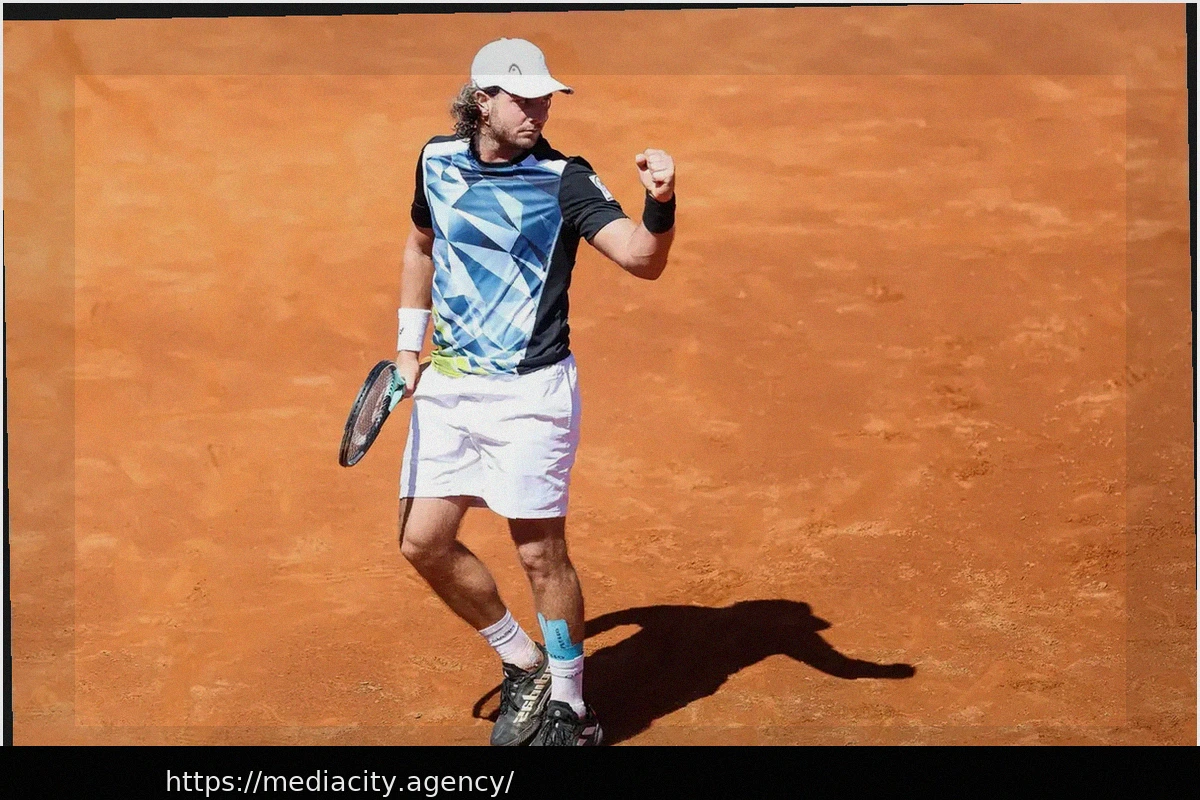
For nearly two decades, Marco Trungelliti existed in the shadows of professional tennis, a talent always on the cusp but never fully breaking through. Now, at 36, he has achieved a long-sought breakthrough, and his extraordinary path illuminates the sport’s selective memory – what it champions and what it often overlooks.
Marco Trungelliti and a Beautiful Tennis Story
April Fool’s Day in Marrakech
On April 1, 2026, in Marrakech, Morocco, Marco Trungelliti, the 36-year-old Argentine, made history. By defeating Polish qualifier Kamil Majchrzak 7-6, 6-3, he became the oldest player in half a century to enter the ATP Top 100 – a remarkable feat made even more fitting by its occurrence on April Fool’s Day, as if plucked from a script.
His journey, punctuated by grueling road trips, encounters with corruption, death threats, bouts of depression, and self-imposed exile, stands as one of contemporary sport’s most compelling narratives. It’s a microcosm of tennis itself – a tale of both its harsh realities and its moments of sublime grace, its economic disparities, and its sheer allure. It reflects how the sport consumes countless aspiring athletes, discarding most, while only a privileged few ever truly shine on its biggest platforms.
Trungelliti was never among that elite group. And perhaps that’s precisely what makes his story so profoundly beautiful.
The Middle of Nowhere
Born on January 31, 1990, in Santiago del Estero – one of Argentina’s most isolated and economically disadvantaged regions – Marco Trungelliti’s tennis journey began watching his parents at the local club, picking up a racket at age five. By fourteen, he made the monumental decision to leave behind his home, family, and all that was familiar, moving first to Chaco, then Buenos Aires, to dedicate himself to the sport. Unlike many competitors from affluent backgrounds who arrive with top academy training, personal coaches, managers, and significant sponsorships, Trungelliti, in his own words, was “the kid from the middle of nowhere,” who, as a pre-teen, chose tennis as his sole path forward.
Turning professional in 2008, his initial seasons were largely confined to South America, immersed in the unseen realm of professional tennis. Here, thousands of players painstakingly compete in ITF Futures events across Latin America, often earning just enough to cover basic expenses like flights and accommodation, meticulously accumulating ranking points. Trungelliti endured years in this unglamorous, untelivised world, far from the spotlight or any media profiles. He simply persevered.
The Art of the Qualifier
By 2012, Trungelliti had battled his way onto the ATP Challenger Tour, the sport’s secondary circuit, making his initial ATP main-draw appearance at the Croatian Open. For the subsequent decade, the Challenger tour became his domain – competing on red clay courts in lesser-known European cities, often before sparse crowds. He claimed sixteen titles at Challenger and ITF levels, with all but one on clay, boasting a career win rate exceeding 62% on the surface. Statistically, he stands as one of the most consistent clay-court players outside of tennis’s elite.
Despite this, his career was long characterized not by his title haul, but by a specific ranking: world No. 112, reached on March 4, 2019. This had been his peak, until recently. The year 2025 marked his most successful period in a while, securing three Challenger titles and reaching four additional semifinals, with 51 wins – his second-highest career total and most since 2018. Yet, the elusive Top 100 barrier persisted, remaining agonizingly just out of reach.
His ATP Tour main-draw record is notably modest, with fewer than twenty wins across his entire career at the highest level. However, this statistic is deceptive, as Trungelliti has almost always had to navigate qualifying rounds to reach the main draw of these tournaments. Without the luxury of wildcards in Argentina or any preferential treatment, each main-draw appearance he earned came after successfully winning three prior matches, before the main competition even commenced.
Paris, By Road
One particular story resonates with tennis fans, even if the name associated with it has faded from memory.
In May 2018, Trungelliti’s French Open hopes seemed dashed after a loss in the final qualifying round on a Thursday. He returned to his home in Barcelona, embarking on a family vacation with his mother, brother, and his 88-year-old grandmother, who was visiting from Argentina.
A call from his coach changed everything: Nick Kyrgios had withdrawn, creating an eighth lucky loser slot, with Trungelliti next in line. His grandmother was in the shower when he excitedly informed her of their impending trip to Paris.
Within minutes, the four of them were on the road.
The ten-hour, 1,000-kilometer drive brought them to Paris just before midnight. With only five hours of sleep, Trungelliti stepped onto the court the next morning and defeated Bernard Tomic in four sets, securing £69,000 in prize money – more than doubling his earnings for the entire year. This unexpected victory also led him to the main press conference room at Roland Garros, an unprecedented experience for him, even after a previous win against a top-ten player.
Celebrating with a beer alongside his grandmother after the match, a now-iconic photograph of her beaming from the stands quickly went viral. By Trungelliti’s own admission, she barely understood the scoring of tennis but perfectly grasped the magnitude of the wonderful event she had witnessed.
She passed away in 2024 at 94. Trungelliti often speaks of that Paris trip as a cherished memory he will carry forever.
The Moment He Chose Integrity Over Everything
Prior to the famous road trip, the viral grandmother photo, and the outpouring of global goodwill, lay a more somber chapter – one Trungelliti tirelessly sought to reveal, yet the tennis world seemed reluctant to acknowledge.
In 2015, a supposed sponsorship opportunity led Trungelliti to a meeting where two individuals meticulously detailed a pervasive match-fixing operation within Argentine tennis. They spoke of payments in briefcases and envelopes, implicating eight players, and quoting prices ranging from a few thousand dollars for a Futures match to $20,000 for a Challenger, and up to $100,000 for an ATP event. They invited him to participate.
He refused. Then, taking a step that would ultimately extract a far heavier toll than he could have imagined, he reported the entire illicit proposal to the Tennis Integrity Unit.
The ensuing investigation, which wrapped up in 2017 with Trungelliti testifying via video call from Barcelona, resulted in bans for three Argentine players. Nicolas Kicker, once ranked as high as world No. 78, received a six-year ban; Patricio Heras was suspended for five years; and Federico Coria received a two-month suspension. These weren’t minor figures; Kicker, notably, was a legitimate Top 100 player.
During the hearing, both Trungelliti and the accused players could see each other on screen – a moment he later described as profoundly unsettling and for which he was wholly unprepared.
For Trungelliti, a crucial distinction exists: he didn’t actively seek out corruption. Instead, it approached him, offered an invitation, and he chose to walk away and report it. This, by any measure, exemplifies the actions of an athlete with unwavering integrity.
Yet, the tennis world’s reaction was far from supportive.
What the Sport Did to Its Whistleblower
The repercussions for his moral stance were severe. Trungelliti endured death threats against himself and his family, his social media accounts were hacked, and he was publicly branded a “snitch” at a 2016 Davis Cup tie. He faced ostracism from segments of the Argentine tennis community. In his subsequent tournament in Buenos Aires, despite being seeded and the highest-ranked Argentine, he lost in the first round of qualifying, attributing it to an unprecedentedly hostile atmosphere.
Official support was conspicuously absent. The Tennis Integrity Unit’s statement on his behalf came a full three months after the investigation went public – not weeks, not days, but months. During this critical period, Trungelliti was left vulnerable and largely isolated.
This prompted him and his wife to relocate from Barcelona to Andorra, as a return to Argentina felt untenable.
The delayed vindication only intensified his bitterness. Once Trungelliti shared his complete story publicly, other players began revealing their own experiences. Novak Djokovic, for instance, admitted being offered $200,000 to throw a first-round match early in his career. Even Sergiy Stakhovsky, who initially labeled Trungelliti a “snitch,” later confessed to receiving similar approaches. Trungelliti reflected that while the pieces of the puzzle eventually aligned, the vindication arrived so late and at such a personal cost that it felt more like a deepening wound than a healing one.
He lauded Novak Djokovic and Vasek Pospisil for establishing the Professional Tennis Players Association, an organization whose meetings he actively participated in. However, he was more critical of others, pointing out that players who stayed silent on corruption, even while maintaining active public profiles through interviews and social media, had, perhaps unintentionally, reinforced the very culture he strove to dismantle.
The Economy of the Invisible Player
The match-fixing scandal, as Trungelliti consistently emphasized, did not materialize in a void. The systemic issues that make match-fixing so enticing are not mere footnotes; they are fundamental to the narrative.
Tennis’s economic model is severely top-heavy, with prize money disproportionately concentrated at the pinnacle. A player like Trungelliti, despite nearly two decades as a professional and career earnings of approximately $1.5 million over that period, still lacks the financial stability enjoyed by a mid-ranked ATP Tour regular. His £69,000 prize from the 2018 Roland Garros first round famously exceeded his earnings for the entire season up to that point – a stark illustration of the sport’s inherent economic structure, not an isolated incident.
He has unreservedly criticized the system, labeling it a “disaster” and challenging the pervasive notion that players outside the Top 100 are inherently inferior and should simply accept any meager rewards. He views this attitude as a form of psychological neglect, a valid assessment. When bookmakers dangle offers of three or four times a Challenger player’s weekly prize money to fix a single set, the allure is undeniable. Trungelliti resisted, yet he notes that most players in his situation aren’t even given the “option” of match-fixing; they are simply left to struggle silently.
The Dark Year, and the Long Way Back
By 2020, Trungelliti found himself on the brink of quitting. He has openly shared the mental torment of that time, confessing to his wife that he couldn’t endure it further, and attending training sessions purely out of habit, devoid of purpose. He was prepared to retire.
Yet, he persevered. The birth of his son, Mauna, with his wife Nadir Ortolani in the scenic Pyrenean region of Andorra, became a turning point. Fatherhood, he revealed, reoriented his priorities and instilled a newfound serenity that had been absent from his tennis for years. He described the aftermath of the match-fixing scandal as triggering a profound depression that lingered for several years, detailing the psychological efforts he made to overcome the deep-seated resentment he harbored.
In 2023, he fulfilled his mother Susana’s lifelong dream of visiting Africa by taking her to the inaugural Rwanda Challenger in Kigali, where he subsequently won the tournament with her watching courtside. The resulting photograph of them together strikingly parallels the iconic image of his grandmother in Paris years earlier, hinting at a recurring theme in Trungelliti’s career: he performs at his peak when surrounded by the love and presence of his family.
By 2025, he had secured three more Challenger titles. Entering 2026 with a career-high ranking, his semifinal performance in Marrakech culminated on April 1st in the achievement that had famously evaded him for nearly twenty years.
What Tennis Is, and What It Could Be
The conventional portrayal of tennis’s beauty often conjures images of Roger Federer’s grace at the net, Rafael Nadal’s dominance on the red clay of Roland Garros, or Carlos Alcaraz’s acrobatic pursuit of a drop shot. While these are valid representations, they offer only a partial view.
True beauty in tennis also resides in the qualifier who drives tirelessly through the night, driven by an unwavering passion for the game. It’s found in the provincial player who courageously reports a match-fixing attempt, subsequently enduring years of threats and ostracism for his integrity. It’s epitomized by the 36-year-old workhorse from Santiago del Estero, who, despite fluctuating rankings (at times below 200, with a pre-breakthrough career-high of 112), consistently appears year after year on obscure clay courts in overlooked towns.
Affectionately known as “Cafe,” a nickname reportedly inspired by his darker complexion and composed demeanor, Trungelliti’s childhood admiration for David Ferrer speaks volumes about his aspirations: to be a player not necessarily defined by raw talent or explosive power, but by sheer relentlessness – a competitor who could be defeated, but never truly broken.
He openly admits he was close to breaking. The severe fallout from the match-fixing scandal, the systemic apathy, and his isolation in a small, distant principality almost led him to quit. What sustained him, he explains, was something more fundamental than ambition: a profound love for tennis. He cherishes the travel, the clay courts, the post-match asados after a grueling week, and the irreplaceable joy of taking his mother to Africa and winning a title in her presence.
From his frantic overnight drive to Paris to discovering new horizons in Kigali, Trungelliti consistently approaches the sport on his own terms, with family, curiosity, and an unshakeable integrity as his constant companions. This perspective, ultimately, captures the true essence of what sport, at its finest, ought to embody.