

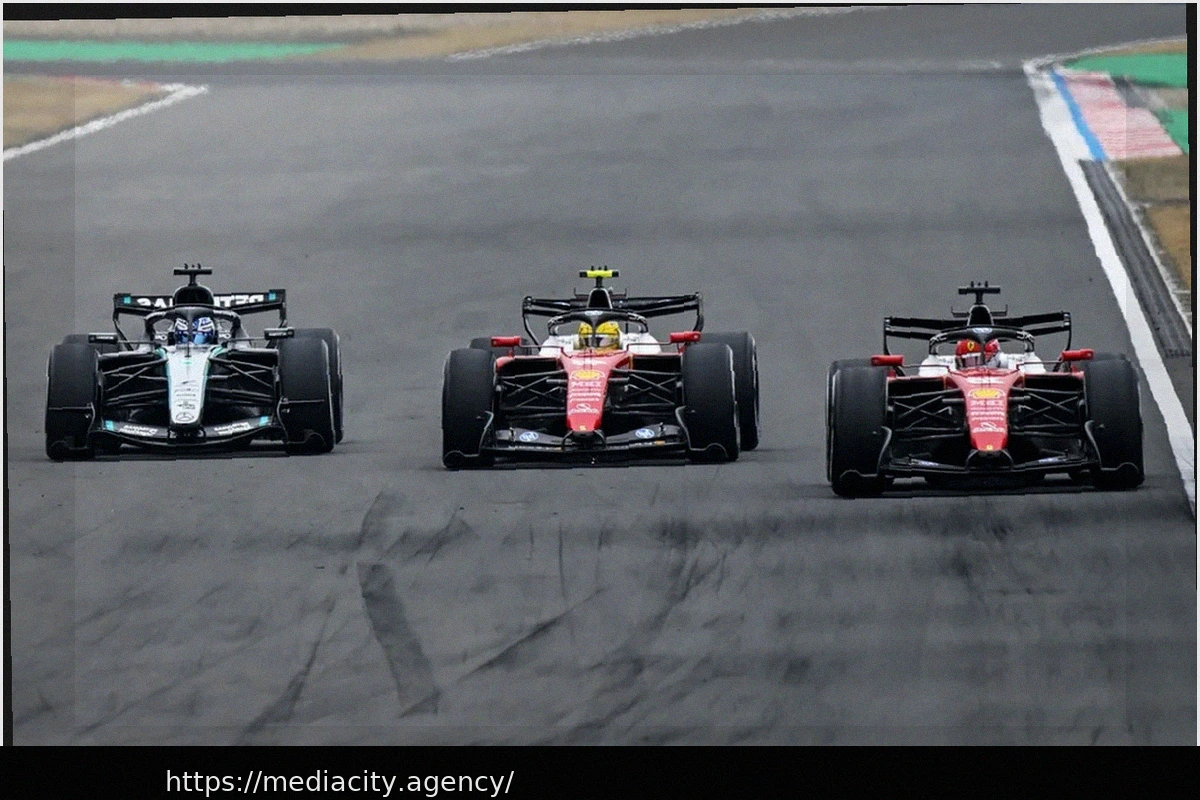
In contemporary Formula 1, optimizing energy management has become a critical factor for lap performance. It’s not just about the raw power from the power unit, but more significantly, how electrical energy is strategically deployed across every meter of the track. This challenge was highlighted by Charles Leclerc, who explained how the energy deployment system reacts to a driver’s braking variations. He stated, “It’s better to never go beyond the limit, always do the same thing, rather than reaching Q3 and trying something new. I’m a bit sad because this used to be one of my strengths, but I’ll get used to it.” The Ferrari driver elaborated that pushing a braking zone too hard or taking a corner differently can disrupt the optimal energy balance for the rest of the lap. This is because the system anticipates a specific amount of energy recovery at each corner, and any deviation in braking impacts the overall energy budget.
Energy Maps: The Foundation of Modern F1
To grasp this phenomenon, one must understand the operational mechanics of the Energy Recovery System (ERS) software, specifically how its deployment module functions. Contrary to common assumption, Formula 1’s energy management system does not rely on real-time, self-learning artificial intelligence models during a lap. However, this doesn’t imply AI has no role in F1. Instead, advanced optimization algorithms are extensively used in team simulators to determine the optimal energy distribution over a lap. These sophisticated models analyze millions of potential combinations to pinpoint the most efficient deployment strategy for each specific circuit. The output of these simulations is then converted into static energy maps, which the power unit’s software executes during the race. Essentially, while AI aids in designing the lap’s energy strategy, the system that implements it on track operates deterministically.

In essence, the team’s simulator meticulously reconstructs each lap, estimating crucial parameters such as braking intensity at every corner, potential energy recovery during deceleration, time spent at full throttle, and the most effective points for electrical energy deployment. The culmination of this process is a detailed energy map for the lap, dictating where energy should be harvested and where it should be deployed. Under ideal circumstances, the system operates straightforwardly: the ERS recovers energy during braking via a generator connected to the rear axle, and this accumulated energy is then released on straights to boost available power. While the foundational energy strategy is developed in the simulator pre-race weekend, engineers’ work persists throughout the event. Free practice sessions are vital for validating how closely simulations align with real-world conditions. Through trackside telemetry, teams measure actual energy recovery during each braking event and consumption rates during acceleration phases. Should these real-world figures diverge from initial predictions, the deployment maps are promptly revised. This iterative process allows the lap’s energy model to be progressively refined according to the circuit’s actual dynamics.
Why a Different Braking Point Can Alter Everything
The critical aspect is that these energy maps rely on a relatively consistent sequence of braking and acceleration points. Each corner is expected to generate a specific amount of energy, which is then utilized on the subsequent straight. If a driver significantly alters their braking phase – for instance, braking later or reducing the duration of deceleration – the amount of energy recovered may differ from what the model anticipates. This is precisely the phenomenon Leclerc alluded to. If the system expects to recover a certain amount of energy at a corner, but the actual recovery is less, the battery might reach the next straight with less energy available than the lap map projected. When this occurs, the power unit’s software must intervene to maintain the energy balance. The most immediate way to do this is to reduce the deployment of electrical energy.

For the driver, this manifests as a sudden loss of acceleration, a phenomenon commonly known as clipping. In reality, the system is simply recalibrating the lap’s energy model to prevent the battery from fully depleting before the lap’s completion. Thus, energy management has evolved into one of the most sophisticated aspects of Formula 1 performance. It transcends mere power unit output, focusing instead on the precise recovery and distribution of energy across the circuit. In this intricate environment, the driver is not solely responsible for pushing the car to its absolute limits but also for providing the energy system with the consistent data required to maintain the lap model’s equilibrium. This delicate balance can be easily disrupted by even minor alterations in braking technique.