

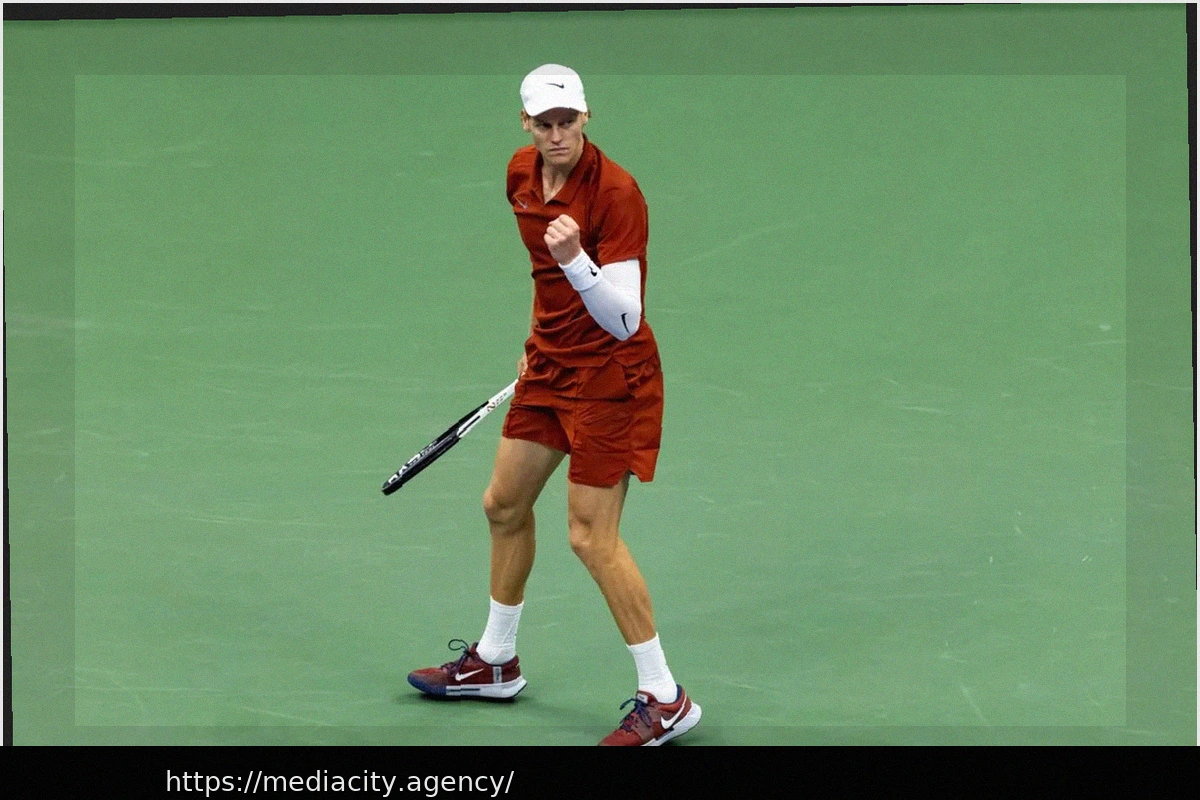
Jannik Sinner’s remarkable achievement of winning both the Indian Wells and Miami Masters events in 2026 marks him as the first man in nearly a decade to complete the “Sunshine Double.” This historic feat inevitably draws comparisons to the last player to achieve it: Roger Federer in 2017. Let’s delve into how Sinner’s success aligns with, and diverges from, Federer’s memorable run.
Key Points of Comparison: Serve and Dominance
Two primary areas highlight the similarities between Sinner’s 2026 and Federer’s 2017 Sunshine Doubles: the exceptional precision of their serving and the overwhelming dominance they displayed throughout their campaigns.
1. Precision Serving: A Shared Weapon
A striking resemblance lies in the pinpoint accuracy of their serves. A prime example from Sinner’s 2026 Miami final illustrates this perfectly. After breaking Jiri Lehecka to lead 2-1 in the first set, Sinner found himself 0-40 down on his own serve. What followed was a truly Federer-esque display, as Sinner delivered five near-perfect serves to hold, extending his lead to 3-1, and ultimately closing out the match 6-4, 6-4.
This pivotal game underscored the significant improvement in Sinner’s serve over the past two and a half years, a development largely attributed to the addition of Darren Cahill to his coaching team. This echoes Federer’s own serve enhancement in the latter part of his career (2017-2018), which contributed to his final three Major titles. Returning from a major injury layoff in late 2016, Federer’s revamped serve and backhand were instrumental in his renewed success.
2. Unrivaled Dominance on the Sunshine Swing
Both Sinner in 2026 and Federer in 2017 exhibited unparalleled dominance during the Sunshine Swing, clinching both Masters titles consecutively and arguably playing some of the best tennis of their careers up to that point.
Sinner arrived at the 2026 Sunshine Swing following his slowest start to a season in three years. Having won the Australian Open in both 2024 and 2025, his bid for a hat-trick ended with a semifinal loss to Novak Djokovic in January, followed by a quarter-final upset in Qatar. Despite this dip in form, Sinner quickly rediscovered his peak performance at Indian Wells.
He proceeded to win both Indian Wells and Miami without dropping a single set. This remarkable streak, combined with his similarly dominant win at the Paris Masters in November, means Sinner has not only matched Rafael Nadal and Novak Djokovic in winning three consecutive Masters titles but has surpassed them by doing so without losing a set across those tournaments.
Federer’s 2017 spring hard-court season was equally triumphant. He swept through Indian Wells without losing a set, including a 6-4, 7-5 victory over Stan Wawrinka in the final. While his Miami campaign was tougher, requiring him to save two match points against Tomas Berdych in the quarter-final, he reasserted his authority by comfortably defeating Rafael Nadal 6-4, 6-3 in the final.
Key Points of Contrast: Style and Career Stage
Despite the striking similarities in their dominant performances, Sinner’s 2026 and Federer’s 2017 Sunshine Doubles also reveal significant differences.
1. Contrasting Styles
While both achieved dominant Sunshine Doubles, their playing styles present a stark contrast. Roger Federer, even years after retirement, remains the epitome of aesthetic excellence in tennis. His fluid movement and graceful artistry on court are considered unmatched. In contrast, Sinner is rarely lauded for his stylistic flair. Perhaps a remnant of his junior skiing background, he maintains a notably upright posture on court, lacking Federer’s natural elegance. Sinner himself has acknowledged a more “robotic” than “artistic” approach, both in style and temperament.
One observer during the Miami final remarked, “I recognise Sinner’s absolute supremacy. But I don’t enjoy his matches. Too one-sided, too clinical, zero emotion. Lendl reborn.” Whether or not one finds his matches captivating, Sinner undoubtedly shares more stylistic and temperamental traits with Ivan Lendl than with Roger Federer.
2. Different Career Stages
The most significant divergence between Federer’s 2017 and Sinner’s 2026 Sunshine Doubles lies in their respective career stages. Federer’s 2017 Miami victory marked his third career Sunshine Double, following earlier successes in 2005 and 2006. This specific triumph, occurring over a decade after his previous ones, may have represented the absolute zenith of his career, showcasing perhaps his finest ever tennis.
Conversely, Sinner is much closer to the beginning of his career than the end. His 2026 Sunshine Double is another monumental achievement in an already burgeoning career, and crucially, it escalates his ongoing “arms race” with Carlos Alcaraz.
Following his 2017 Sunshine Double, Federer strategically withdrew from the ATP Tour, skipping the entire European clay-court season, including the French Open, to protect his then 36-year-old body. This decision famously paid off, as he went on to win his eighth Wimbledon title, solidifying his status as the greatest male grass-court player.
For Sinner in 2026, the strategy is diametrically opposed. Far from withdrawing, he will be redoubling his efforts, particularly with the European clay-court season commencing in Monte-Carlo. Having missed most of the 2025 clay season due to a doping ban, Sinner has virtually no points to defend, providing a strong incentive to challenge Carlos Alcaraz for the top spot in the world rankings.
Sinner’s focus will be laser-sharp on winning the French Open, not only to avenge his heartbreaking loss to Alcaraz in last year’s final but also to complete his Career Grand Slam, a feat Alcaraz achieved earlier this year. While Federer in 2017 aimed for a record-breaking eighth Wimbledon, Sinner in 2026 has his sights set firmly on a maiden French Open title. If he can emulate Federer’s ability to follow up a Sunshine Double with Grand Slam success, he stands a strong chance of achieving it.