

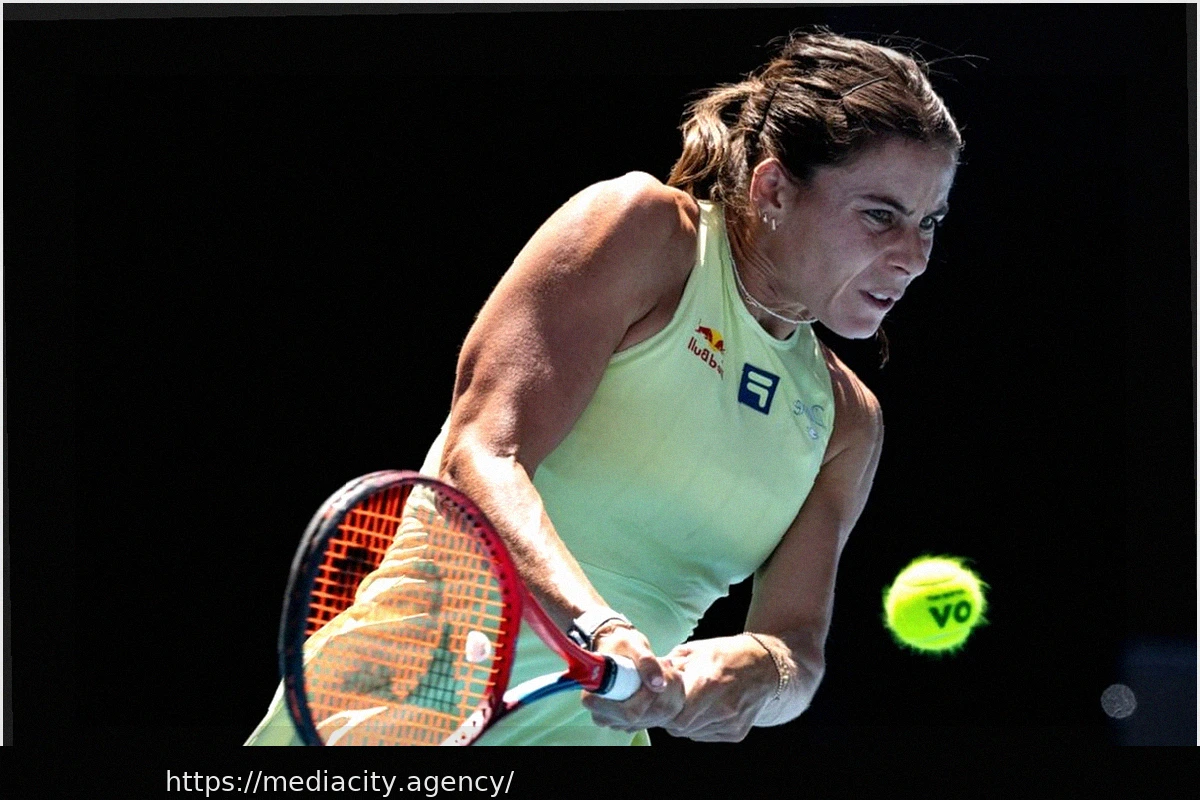
From roughly 2022 to 2024, the WTA tour saw a proliferation of a distinct type of tennis player: the baseline grinder. These athletes weren’t typically known for exceptional power or explosive movement, but they excelled through phenomenal footwork, masterful point construction, and a potent topspin forehand capable of finding acute angles or pushing opponents deep behind the baseline. This playing style proved incredibly effective, capitalizing on a temporary tactical void. Many players on the tour had yet to master stepping in and attacking these high, heavy balls early, consequently being forced back and consistently outmaneuvered.
Iga Swiatek epitomized this era’s success, reaching her peak dominance in early 2022 with a remarkable 37-match winning streak, the longest on the WTA tour in the 21st century. Emma Navarro also flourished under these conditions. Her game relied on meticulous point management, adept double-sided slicing to alleviate pressure, and a topspin-focused approach that, when strategically applied, formed a highly effective overall package. As recently as 2024, this strategy propelled her to a career-high world No. 8 ranking and a US Open semifinal appearance.
However, just two months into 2026, Navarro’s record stands at a concerning 4-8. She began the year ranked 15th but has since fallen to 25th, and her trajectory continues downwards.
The Evolving Landscape Around Her
Conventional wisdom often attributes such dips in performance to psychological or situational factors, such as a “sophomore slump,” loss of confidence, injuries, or difficult draws. While these elements might certainly play a role – Navarro herself acknowledged a challenging 2025 in Auckland – focusing solely on psychology overlooks a more fundamental, structural shift: the tactical environment that once made her playing style so effective has fundamentally changed, and she has yet to adapt.
The WTA tour of 2026 is significantly more aggressive than it was when Navarro began her ascent. The players who have solidified their positions at the top—Sabalenka, Rybakina, Gauff, and Anisimova—are all characterized by their willingness and ability to take the ball early, hit through pace rather than merely redirect it, and generate or absorb power instead of relying heavily on spin manipulation. Crucially, this aggressive approach is no longer confined to the elite. It has permeated throughout the tour. Modern WTA returners, whether through coaching or repeated exposure to power hitters like Sabalenka, are now trained to step into the court and drive through heavy topspin, rather than retreating and waiting. What once was a destabilizing, high-bouncing ball that pushed opponents into defensive positions now often meets a racket already poised to send it back flat and hard.
Jelena Ostapenko’s influence on Swiatek offers a clear illustration of this ongoing trend. Ostapenko’s all-or-nothing style, marked by her aggressive court positioning and pursuit of winners even on service returns, transformed matches against topspin specialists into unpredictable coin flips. For most of her career, Ostapenko was unique in adopting this strategy before much of the tour caught on, often playing with minimal regard for margins. Now, the tour has largely arrived at similar conclusions, albeit with more measured execution. Players no longer need to be as reckless as Ostapenko to neutralize a heavy spinner. They simply need to be comfortable enough with pace to connect with the ball at hip height and drive through it. Swiatek’s topspin, despite its immense RPMs, achieves its most dangerous bounce on traditional clay. On faster surfaces, that same ball often sits up just enough to be attacked effectively.
Why This Impacts Navarro More Than Swiatek
For Iga Swiatek, an all-time great with six Grand Slam titles and the tactical intelligence to evolve, this shift presents a challenge, but not a crisis. She won Wimbledon in 2025, secured three titles overall, and achieved 62 tour match wins—her fourth consecutive season with 60+ wins, a feat unseen since Hingis and Davenport at the turn of the century. She has adapted successfully before and is capable of doing so again. Her topspin remains a potent weapon, even if partially neutralized, compelling her to discover and utilize other pathways to victory. Ultimately, for Swiatek, the tactical adjustment is real but manageable.
For Emma Navarro, however, the situation is more urgent because she lacks the extensive arsenal Swiatek possesses when one weapon becomes less effective. As one analyst observed during her ascent, there’s little in Navarro’s game that overtly stamps her as a future world-beater. Her strengths coalesce into a carefully managed system. When opponents were still learning to anticipate heavy topspin and were unprepared for long, grinding baseline rallies, that system was more than sufficient. It brought her a US Open semifinal, a Wimbledon quarterfinal, and a world No. 8 ranking. Yet, a meticulously managed system has a narrower margin for error than a power-based game. When opponents grow comfortable with these conditions—as Beatriz Haddad Maia demonstrated in 2025 by consistently attacking Navarro’s heavy topspin forehand with her left-handed backhand on clay—the entire package can unravel far more quickly than it was built.
A telling detail surfaced this season when Zhang Shuai, ranked 86th and playing as a qualifier, defeated Navarro. Zhang herself offered a candid post-match assessment, stating she did nothing special, simply enjoying the pace of Navarro’s balls, while Navarro seemed uncomfortable with hers. This seemingly minor comment highlights a larger issue: when a qualifier is so at ease with your game that they express enjoyment in playing against it, your strategic blueprint is no longer a secret or a significant threat.
What Lies Ahead
None of this suggests that Navarro’s career is over. She is 24, and her rise through the rankings was unusually late by WTA standards. She first entered the top 100 just before her 22nd birthday, indicating a different developmental path that might also allow for unique adaptations. Late bloomers sometimes possess deeper technical foundations precisely because they weren’t prematurely pushed into elite competition. She also has a full clay season ahead, a surface that historically favors heavy spinners more than hard courts, as slower conditions provide the ball more time to climb, bite, and push opponents back.
However, the required adaptations are substantial. To thrive at this level when opponents are adept at hitting through your spin, a player needs either increased pace to reduce their opponent’s reaction time, improved court positioning to cut off their swing, a more diverse tactical repertoire, or a combination of these elements. By “Aggression Score,” a metric that rewards early ball striking and point-ending initiatives, Navarro ranks below average on the WTA tour, aligning with players outside the top ten.
The tactical window that her style so brilliantly exploited—where a meticulously constructed topspin game could dismantle unprepared opponents—did not shut abruptly. It gradually narrowed, across hundreds of matches at every level of the tour, as players learned, adjusted, and began to arrive on court with more effective countermeasures. The window isn’t entirely closed, but it is significantly smaller than it once was, and navigating it now demands more than just careful management.
This is the challenge awaiting Emma Navarro in Miami and at every subsequent tournament.