

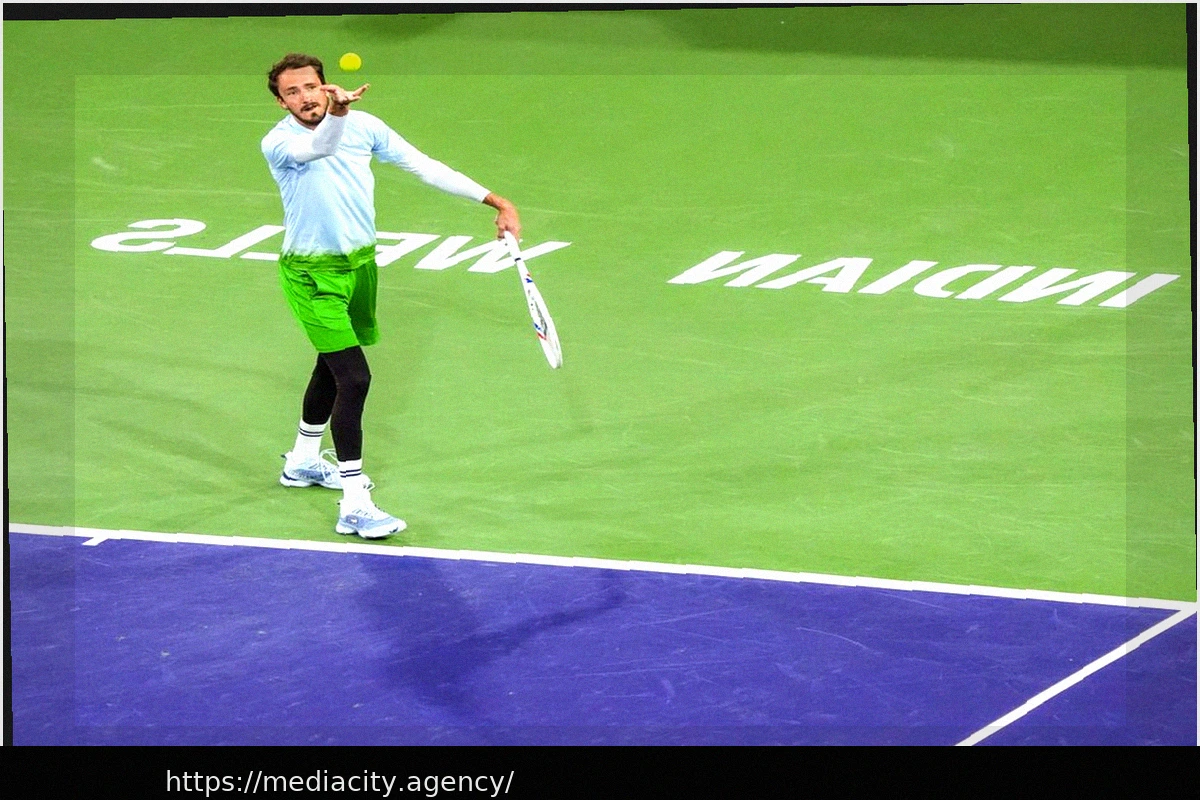
The ATP Indian Wells Semifinals provided drama that the tour initially welcomed — until the secondary ticket market revealed its true sentiment.
The Market’s Verdict: A $200 Collapse
On March 14th, Daniil Medvedev stepped onto Stadium 1 at Indian Wells and decisively defeated Carlos Alcaraz 6-3, 7-6(3), breaking the Spaniard’s 34-match unbeaten streak and inflicting his first loss of the year. Medvedev’s presence there was already remarkable. With UAE airspace closed following Iranian strikes, he undertook a grueling six-hour drive from Dubai, where he was champion, to Oman with Andrey Rublev and Karen Khachanov. From there, he caught a flight to Istanbul, then connected to the United States, arriving just two days before his opening match. “You feel like you’re in a Hollywood movie,” he later remarked. Despite the ordeal, his performance was anything but cinematic; it was the focused, relentless display of a man who seemed to have been preparing for this encounter with Alcaraz for two years.
However, the secondary market soon delivered its stark assessment. “Get-in” prices for Sunday’s final plummeted from over $400 to approximately $200 within hours—a staggering 50% drop. It became clear that while casual fans would pay a premium for the “Hollywood matchup” of Sinner vs. Alcaraz, a Sinner vs. Medvedev final was perceived as a different, less valuable product. Ironically, the final itself proved to be a genuine thriller, with Medvedev surging to a 4-0 lead in the second-set tiebreak before Sinner won seven consecutive points to clinch the match and achieve a career-best hard court record. Yet, the market had already rendered its judgment before the first ball was even struck.
The Tour’s Need for Multiple Stars
This single data point encapsulates the ATP’s central challenge. The tour requires at least three—and ideally four—top-tier stars to thrive and keep men’s tennis consistently in the global sporting conversation. The era of the “Big Three” worked precisely because Federer, Nadal, and Djokovic generated rotating storylines, cultivated overlapping fanbases, and ensured enough unpredictability that no week felt predetermined. Even smaller tournaments, like the 500s and some 250s, flourished due to this depth, selling tickets and TV packages on the assurance that a genuine star would compete and make a difference. Without such a strong roster, smaller events struggle to attract crowds, broadcasters find it harder to promote the product, and the overall ecosystem slowly diminishes. While “Sincaraz” (Sinner vs. Alcaraz) offers a compelling rivalry from Riyadh and Las Vegas to New York, it alone does not constitute an entire tour.
Medvedev’s Unexpected 2026 Resurgence
Medvedev’s performance in 2025 suggested he was stepping away from the top-tier conversation. He finished the year ranked 13th, won only one match across all four Grand Slams, and parted ways with his long-time coach Gilles Cervara. It appeared less like a strategic reset and more like an impending decline. Then, 2026 arrived. Under his new coach, Thomas Johansson, he claimed titles in Brisbane and Dubai, entering Indian Wells on a formidable winning streak. Suddenly, the most distinctive player on the hard-court circuit was back to his best: making the world’s top two deeply uncomfortable.
Arguments For and Against the Russian Veteran
The case for Medvedev as the tour’s crucial third wheel is robust. His press conferences alone are worth the admission price—dry, self-aware, and instantly quotable. His on-court volatility—the occasional racquet smash followed by clinical comebacks—makes for gripping television. However, the arguments against him are equally significant. Casual fans often find his unpredictability off-putting, and there’s no universally clean narrative hook that easily translates across different markets. Winning the 2021 US Open and reaching five other Grand Slam finals, while impressive, hasn’t been enough to elevate him to truly global celebrity status.
The Marketability Discrepancy
There’s a distinct gap between being a compelling athlete and being a highly marketable one, and Daniil Medvedev occupies this space squarely. His game is tactically unusual and often disruptive, transforming matches into intricate puzzles rather than spectacular displays. For tennis purists, this unconventional style is part of his appeal. For broader, casual audiences, however, it can be harder to connect with.
This contrast becomes even clearer when compared to his peers. Carlos Alcaraz exudes explosiveness and charisma. Jannik Sinner offers clean, consistent dominance and a rivalry that effortlessly promotes itself. Medvedev, in comparison, deliberately breaks rhythm and expectations—an effective strategy, but one that is less immediately accessible to a mass audience.
External factors also play a role. Competing under a neutral flag due to Russia’s war in Ukraine significantly impacts his commercial potential. Sponsors, broadcasters, and tournament organizers operate within these constraints, which influences how he is positioned and promoted. His current sponsorship portfolio reflects a commercial ceiling that typically doesn’t exist for stars from the EU, UK, or USA.
This situation highlights the core tension within the ATP today. The tour doesn’t merely need players who can win; it desperately needs players who can be effectively marketed. Medvedev can still defeat anyone on a hard court. The fundamental question is whether that is enough to sustain an entire ecosystem that relies on something more straightforward than sheer skill.
A Scarcity of Alternatives
When searching for cleaner, more universally marketable alternatives, the options quickly diminish. Novak Djokovic, while extraordinary, has a schedule limited by his age. Alexander Zverev continues to battle mental fragility, Taylor Fritz has yet to deliver the definitive “moment” that would transform his narrative, Ben Shelton is still in the process of realizing his immense promise, and Jack Draper’s health remains a persistent concern. While the actual “next-gen” future shows promise with talents like Learner Tien, Joao Fonseca, and Jakub Mensik, they are currently in the crucial transition phase from exciting prospects to tour-carrying stars. Tien even secured a bagel against Medvedev at the Australian Open this year—a clear sign that change is on the horizon, but the new guard isn’t quite ready to surge into the top 10 just yet.
A Depth Challenge, Not a Medvedev Problem
Ultimately, until the youth movement fully matures, Medvedev is the pivotal player the ATP has. He navigated an arduous journey through Oman and Istanbul, defeated the world No. 1, and pushed the world No. 2 to the absolute brink. He accomplished all of this after a year that most players would struggle to recover from. One star missing from a Masters 1000 final inevitably means money left on the table, a fact clearly confirmed by the resale market. However, a dramatic final still unfolded, even if a segment of the casual audience had already disengaged. This isn’t a “Medvedev problem”; it’s a broader depth problem within men’s tennis. And right now, the 30-year-old from Moscow is the one actively confronting it, taking on the sport’s freight train talents head-on.